Airport parking is different from every other parking environment in ways that matter operationally. The demand is genuinely unpredictable — a single weather system or ATC delay can hold 400 aircraft, stranding thousands of passengers and converting 12-hour expected stays into 30-hour actual stays. The customer mix spans daily commuters to once-a-year travelers who have never parked at this airport before. The competitive pressure from TNCs (transportation network companies — Uber and Lyft) is direct, measurable, and growing. And the revenue stakes are significant: parking and ground transportation are typically among the largest non-aeronautical revenue sources for major airports.
These characteristics make airports both the most challenging parking management environment and one of the most active deployment sites for advanced parking technology. The operational complexity creates clear use cases for guidance, dynamic pricing, LPR, predictive analytics, and integrated mobility management. The revenue stakes justify the investment. And the scale — major airports commonly manage 15,000 to 80,000 parking spaces across multiple products (hourly, daily, weekly, reserved, employee) — creates the data volume that makes analytics and machine learning genuinely useful.
The Demand Characteristics That Drive Technology Choices
Flight-Driven Demand Volatility
Airport parking demand is anchored to flight schedules, but actual parking behavior follows actual flight operations — which diverge from schedules constantly. A passenger catching a 6 AM departure returns at a nominal arrival time; if the return flight is delayed by four hours, the parking session extends. A passenger planning a four-day trip may find their flight cancelled and turn a four-day session into an overnight before rebooking.
Traditional revenue management approaches that model airport parking demand on scheduled departures and arrivals miss this volatility. Smart parking systems that integrate flight status data — in real time from the FAA’s ASDI (Aircraft Situation Display to Industry) feed or through commercial flight data APIs — can adjust occupancy forecasts dynamically as delays and cancellations propagate through the flight schedule.
This is not merely an analytical nicety: it directly affects space availability management. When a wave of inbound delays extends sessions across a large share of the parking inventory, capacity planning for arrivals later in the day must account for the reduced turnover. A system that predicts this two to four hours in advance can implement availability routing or temporary rate adjustments before the physical shortage develops.
Multi-Product Complexity
Major airport parking operations typically offer five to eight distinct parking products with different pricing, proximity, amenity levels, and customer expectations:
- Terminal parking (hourly): High-rate, close-proximity short-term parking for drop-off/pick-up and short stays
- Daily parking (on-airport): Mid-range pricing, structured or surface, shuttle-served or walk-up
- Economy parking: Lower-rate, typically remote with shuttle service
- Reserved/guaranteed parking: Pre-booked at premium price with space availability guarantee
- Valet: Premium service at highest price point
- Employee and crew parking: Managed separately from public inventory
- Rental car ready/return: Complex access and utilization dynamics tied to rental fleet management
Managing these products as an integrated system — where demand forecasting and pricing optimization considers inter-product substitution — is a capability that relatively few airport operators have achieved. Most still manage each product in relative isolation, leaving revenue optimization opportunities unused.
TNC Competition and the Revenue Gap
Rideshare pickup zones at airports have transformed airport ground transportation economics. Before Uber and Lyft achieved widespread adoption, passengers choosing not to drive had the options of taxi, shuttle, and car service. These are relatively high-cost and typically took similar time to driving and parking. Rideshare introduced a lower-cost, high-convenience alternative that directly substitutes for airport parking for trip lengths where the round-trip cost differential is meaningful.
The substitution effect is most pronounced in short-trip markets — travelers whose home airport is within 30 to 45 minutes of their residence, where the round-trip Uber cost is less than a day’s parking. Industry data suggests airport parking transaction volumes at major U.S. airports declined 15 to 25 percent between 2015 and 2019 as rideshare adoption grew, before pandemic effects made trend isolation difficult.
Smart parking’s contribution to the TNC competitive response includes: dynamic pricing that makes airport parking more price-competitive at the margin for value-sensitive travelers; pre-booking platforms that provide the reservation certainty rideshare cannot; premium products (guaranteed reserved spaces, valet with complimentary services) that compete on convenience rather than price; and integrated arrival alerts that improve the parking experience through seamless entry and exit.
Technology Applications in Airport Parking
License Plate Recognition at Scale
Airport LPR deployments are among the most demanding in the parking industry. Thousands of vehicles enter and exit across dozens of lanes with widely varying lighting conditions, vehicle types (personal vehicles, rental cars, commercial shuttles, limousines), and plate formats from all 50 states plus international plates for international terminal parking.
Airport LPR serves multiple functions beyond occupancy counting: automated billing for license plate-registered accounts, enforcement of time limits in short-term areas, tracking of monthly permit use, and flagging of vehicles with outstanding citations or security alerts (in coordination with airport authority security programs).
Read accuracy requirements for billing applications are higher than for occupancy guidance — errors in billing reads produce customer service issues and potential legal exposure. Leading airport LPR deployments report read accuracy of 97 to 99 percent for domestic plates in controlled entry lane conditions. Exception handling for misreads and unread plates requires clear protocols that are designed before deployment, not improvised after.
Dynamic Pricing With Product Substitution
Airport parking dynamic pricing is more complex than single-facility dynamic pricing because it must account for inter-product substitution. When daily parking rates rise, some customers substitute to economy parking — the price elasticity of demand for daily parking is partly a function of the economy parking price.
Sophisticated revenue management systems for airports model the full demand system across products, not individual product demand in isolation. Rate changes for one product are evaluated in the context of their effect on demand for all products simultaneously. This is the same approach used in airline revenue management — not coincidentally, since airport parking revenue management has borrowed heavily from airline yield management methodology.
The Federal Highway Administration’s research on transportation demand management at fhwa.dot.gov includes analysis of airport parking pricing strategies and their measurable effects on travel behavior and transportation mode choice.
Wayfinding in Complex Multi-Level Environments
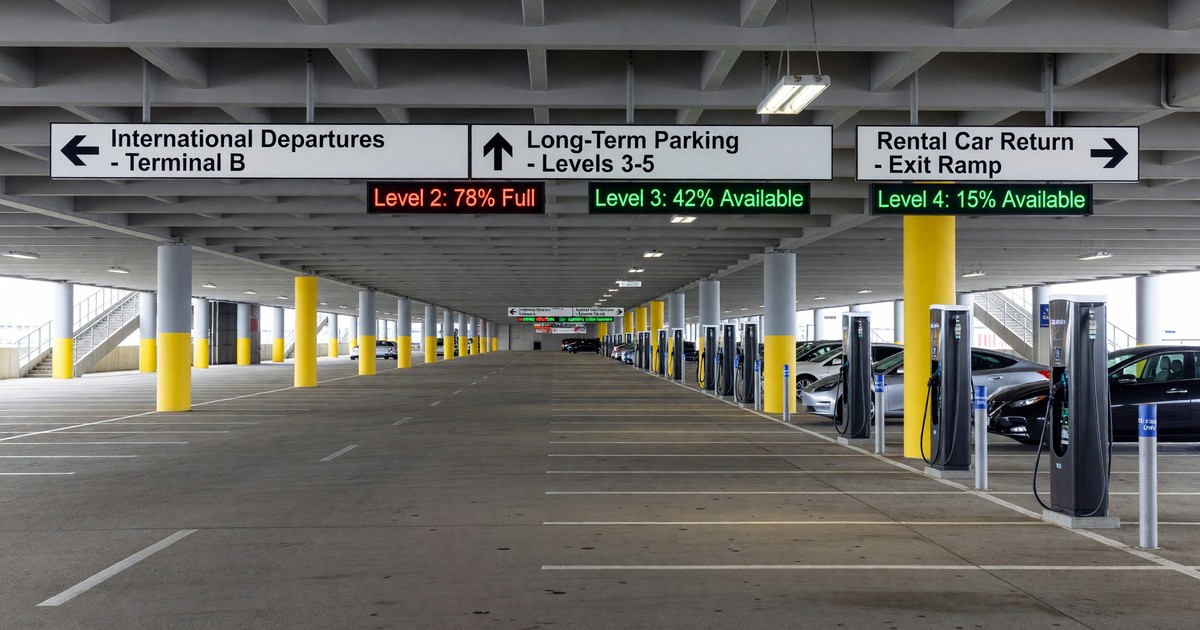
Airport parking structures are among the largest and most navigation-challenging built environments that ordinary travelers encounter. A single structure may span 10 or more levels with thousands of spaces, connected to a terminal via one or more skybridge or elevator access points.
Dynamic wayfinding — signs that display available space counts by level and direct drivers to the level most likely to have spaces — reduces search time and distributes occupancy more evenly across the structure. LED space availability indicators (green for open, red for occupied) at the individual space level further reduce search time once a driver is on the correct level.
At the campus level, variable message signs at garage entry points display availability across multiple products, allowing drivers to make product choice decisions before entering a structure rather than after. Systems that integrate with the airport’s existing signage infrastructure (flight information displays, roadway signs) maximize the reach of this information.
Pre-Arrival Digital Experience
Travelers planning airport trips have a high willingness to engage with digital parking interfaces before arrival — they are in planning mode, with a defined trip that creates a clear need. This creates an opportunity for pre-booking, pre-payment, and informational engagement that is less available in transient urban parking contexts where the decision is made closer to arrival.
Airport parking apps and online reservation systems capture pre-arrival intent, converting it to confirmed bookings that guarantee revenue, smooth demand peaks, and enable pre-communication about available products, shuttle schedules, and facility conditions. The data from pre-bookings also feeds demand forecasting models, improving occupancy prediction accuracy.
Integration of airport parking reservations with airline booking platforms is an active development area. When a traveler books a flight, the natural next question is how they will get to the airport — and a parking upsell at the point of airline ticket purchase, with the flight information pre-populated, converts at far higher rates than a separate parking sales interaction.
Automated Revenue and Audit Systems
Airport parking revenue is large and operationally complex — thousands of transactions per day across multiple payment types, products, and facility locations. Revenue leakage (vehicles exiting without paying, payment processing errors, validation abuse) at airport scale can represent material dollar amounts.
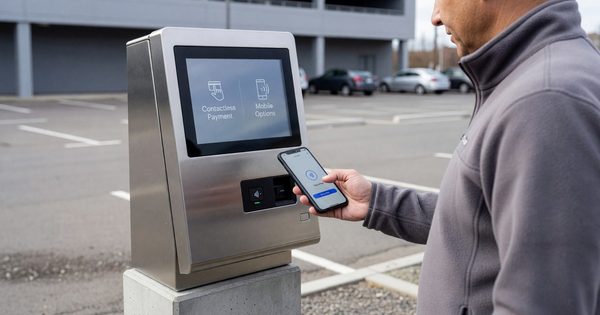
Automated revenue audit systems cross-reference entry events (LPR reads or ticket pulls at entry), exit events (payment transaction records and exit lane reads), and payment records to identify discrepancies: vehicles with entry records but no payment records, vehicles exiting via a lane with no corresponding entry record, validation transactions that don’t match corresponding parking sessions.
Airports that implement systematic revenue audit systems typically identify leakage rates of 2 to 5 percent of total revenue in initial audits — meaningful sums at the revenue scale of major airport parking operations. The ROI on audit systems, once identified leakage is recovered through operational correction, is typically very high.
Accessibility and ADA Compliance
Airport parking must meet or exceed ADA accessibility requirements for accessible spaces, pathway clearances, and accessible shuttle services. Smart parking technology intersects with accessibility compliance in several ways.
Per-space occupancy monitoring of accessible spaces — displaying accessible space availability on guidance systems and in mobile apps — helps travelers with disabilities plan and navigate without the uncertainty of not knowing whether an accessible space will be available.
The U.S. Access Board provides technical guidance on accessible parking facilities and routes at access-board.gov, including slope requirements, signage standards, and van-accessible space specifications that inform facility design and audit.
Pre-arrival reservation of accessible spaces — allowing travelers with disabilities to confirm an accessible space before departure — is a meaningful service improvement that smart parking reservation systems can provide.
The Competitive Positioning of Airport Parking
The airports that are winning the TNC competition for parking revenue are not doing so primarily on price — competing with rideshare on price alone is a losing strategy, because the cost structure of parking at scale (debt service on structures, maintenance, staffing, capital replacement) is less flexible than rideshare pricing. Instead, winning airports compete on certainty, convenience, and the totality of the parking experience.
Certainty means knowing you have a space: pre-booked, guaranteed, accessible. Convenience means seamless entry and exit, clear wayfinding, proximity to the terminal. Experience means clean facilities, reliable shuttle service, clear signage, easy payment, and responsive customer service when things go wrong.
Smart parking technology enables all three — but only when it is integrated into a coherent customer experience rather than deployed as disconnected point solutions. The airports that deploy guidance without pre-booking, or pre-booking without dynamic pricing, or LPR without back-office reconciliation, get partial benefit from each technology rather than the compounding benefit of an integrated system.
Related: AI-Powered Parking Guidance Systems for the guidance technology layer, and Smart Parking Payment Innovations for the payment experience that completes the airport parking journey.
Frequently Asked Questions
How does flight delay data improve airport parking management?
Integrating real-time flight status data allows parking management systems to update occupancy forecasts dynamically as delays propagate through the schedule. When a wave of inbound delays extends parking sessions beyond planned durations, a flight-aware system can predict the reduced turnover 2 to 4 hours in advance and adjust availability routing or pricing before a physical space shortage develops. This is qualitatively different from count-based systems that only respond to conditions after they occur.
How has rideshare affected airport parking revenue?
Industry data suggests major U.S. airports experienced 15 to 25 percent declines in parking transaction volumes between 2015 and 2019 as rideshare adoption grew. The substitution effect is strongest for short-trip travelers (within 30 to 45 minutes of the airport) where the round-trip rideshare cost is comparable to a day or two of parking. Airports respond through dynamic pricing, premium guaranteed products, improved convenience, and pre-booking platforms that provide the certainty advantage over rideshare’s variable availability.
What LPR accuracy is required for airport parking billing applications?
Airport LPR deployments used for automated billing require higher accuracy than guidance applications because read errors produce direct customer service issues and potential billing disputes. Production accuracy for domestic plates in controlled entry lane conditions ranges from 97 to 99 percent for leading systems. Exception handling protocols for the 1 to 3 percent of misreads or unread plates — covering fee assessment, customer dispute resolution, and revenue recovery — must be defined before deployment.
What is airport parking dynamic pricing and how does it work?
Airport dynamic pricing adjusts rates across products (daily, economy, reserved, valet) in response to real-time and forecast occupancy, advancing the same reservation logic that airlines have used for decades. Sophisticated airport revenue management systems model inter-product demand — accounting for the fact that daily parking rate increases shift some demand to economy parking — rather than pricing each product in isolation. Rate changes can be implemented through online booking platforms, mobile apps, and connected pay stations.
How do accessibility requirements affect smart parking technology choices at airports?
ADA and related requirements mandate accessible spaces at specified ratios, accessible pathways, and van-accessible spaces with additional clearance. Smart parking technology intersects with compliance in: per-space monitoring of accessible spaces for guidance and availability display; pre-arrival reservation of accessible spaces; route wayfinding that directs travelers with disabilities to appropriate spaces and paths; and automated monitoring that can alert operators when accessible spaces are occupied by non-permitted vehicles.
What does airport parking revenue audit technology detect?
Revenue audit systems cross-reference entry records (LPR reads or ticket events), exit records (exit lane reads and payment transactions), and payment records to identify discrepancies. Common leakage patterns detected include: vehicles with entry records but no corresponding payment record (unpaid sessions), vehicles exiting through lanes with no recorded entry (tailgating or lane bypass), and validation transactions that don’t match valid parking sessions (validation abuse). Initial audits at airports implementing systematic audit systems typically identify leakage of 2 to 5 percent of total revenue.
Further Reading From Authoritative Sources
- FHWA — Transportation Demand Management and Pricing Research: The Federal Highway Administration documents airport parking pricing strategies, TNC demand management, and transportation mode choice research relevant to airport ground transportation planning.
- U.S. Access Board — Accessible Parking Facilities: The U.S. Access Board provides technical standards for accessible parking, including space counts, dimensional requirements, signage standards, and route accessibility requirements applicable to airport parking facilities.