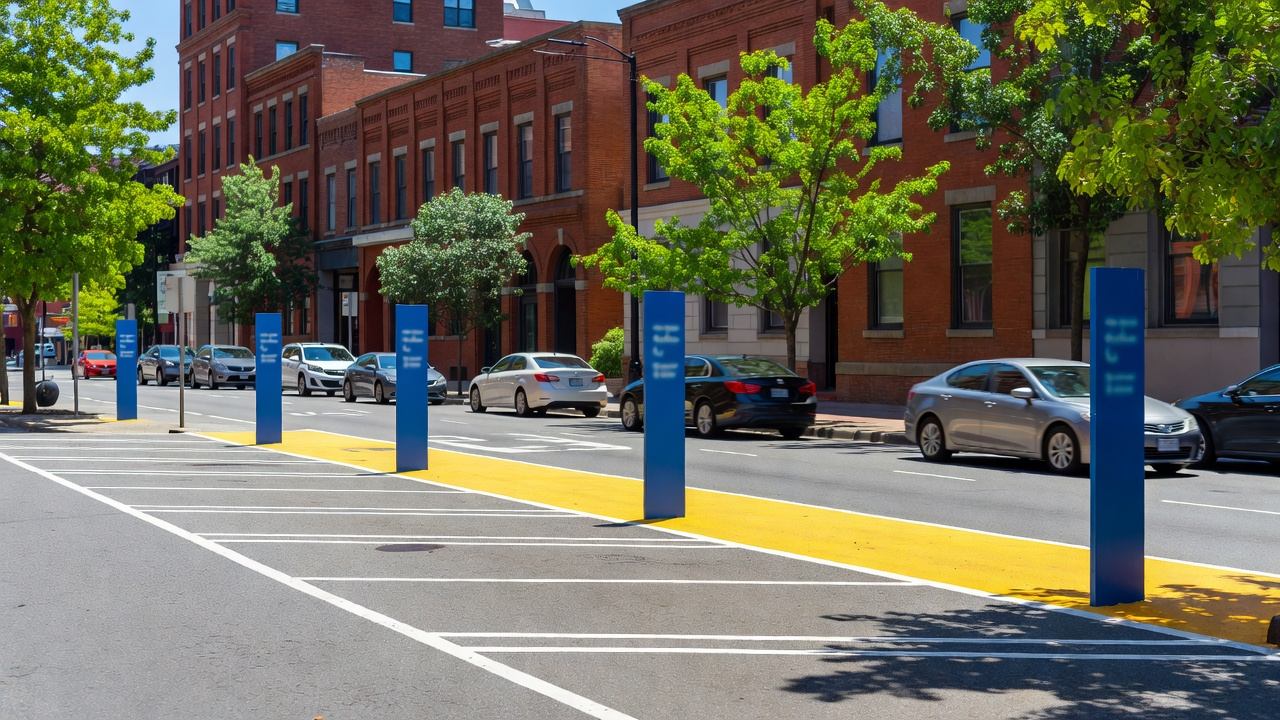
INRIX announced an integration with Cleverciti on June 9, 2026, adding verified real-time on-street parking availability at block and curb-segment level to its platform. Cleverciti’s contribution is its detection layer — street-level overhead sensors with computer vision, continuously updating occupancy rather than inferring it from historical trends.
The arrangement runs both ways: Cleverciti occupancy data flows into the INRIX platform, and Cleverciti customers gain access to INRIX curb data through CleverPortal.
Taken alone that is a partnership announcement. Taken alongside INRIX’s integration with Automotus, which extended real-time parking and loading occupancy coverage to 13 additional cities, it describes something more useful to buyers: an aggregation layer accumulating multiple independent sensing sources.
The layers are separating
Curb technology has been sold as a stack. A vendor supplied the sensors, the platform that read them, and the applications on top, and buying any part meant buying all of it.
A distribution platform integrating several detection vendors breaks that. The sensing decision and the data-platform decision become two decisions, and they can be made on different criteria and on different timelines.
That is straightforwardly good for cities, because the two have genuinely different lifecycles. Sensors are capital, mounted on physical infrastructure, with a replacement cycle measured in many years and a deployment cost dominated by installation. A data platform is a subscription that can in principle be changed at renewal. Locking the second to the first has historically meant a city’s analytics choices were fixed by a hardware decision made years earlier.
Verified beats inferred, and the distinction is the product
The wording that carries the most weight in the announcement is that the availability is verified and continuously updated, rather than relying primarily on historical trends or inferred availability.
This is the real dividing line in curb data. Inferred availability — modelled from payment transactions, historical patterns, and probe data — is inexpensive, covers wide areas, and is adequate for guidance where being approximately right is enough. Verified availability comes from something actually observing the space.
The uses named for the combined platform sort cleanly along that line. Parking guidance tolerates inference. Demand-based pricing and curbside compliance do not, because both make consequential decisions about individual segments — one sets a price, the other supports enforcement. A city intending either needs to know which segments are verified and which are modelled, and that distinction should appear in the contract rather than in the marketing.
What buyers should ask
Which segments are verified and which are inferred? Coverage maps blend the two. A single “coverage” figure is not usable for a pricing or compliance programme.
What is the confidence and latency, per segment? Block-level real-time is a claim about both accuracy and freshness. Both should be specified and measurable.
Does the data leave in a documented format? Aggregation platforms reduce sensor lock-in and can increase platform lock-in. Export rights and format documentation are what preserve the flexibility the multi-vendor arrangement created.
What happens to the data relationship if the partnership ends? The bidirectional structure means a city may be receiving data through an agreement between two vendors that it is not party to. Ask what happens to continuity if that agreement lapses.
Can a second sensing vendor be added later? This is the actual test of whether the architecture is genuinely multi-vendor or is one integration presented as an architecture.
The procurement change
The practical implication is to stop issuing single procurements for “a curb management system.”
Separating them — a sensing procurement judged on detection accuracy, installation impact, maintenance, and physical lifecycle, and a platform procurement judged on integrations, data rights, latency, and applications — lets each be evaluated on what actually matters for it, and lets the shorter-cycle decision be revisited without disturbing the longer one.
Cities that have already deployed detection have the most to gain. An existing sensor estate that can now feed a platform chosen separately is infrastructure whose value extends rather than expiring with its original vendor relationship — which is precisely the “maximise the value of existing parking infrastructure” case the partnership is making, and the part of it that holds up independently of any vendor’s claims.