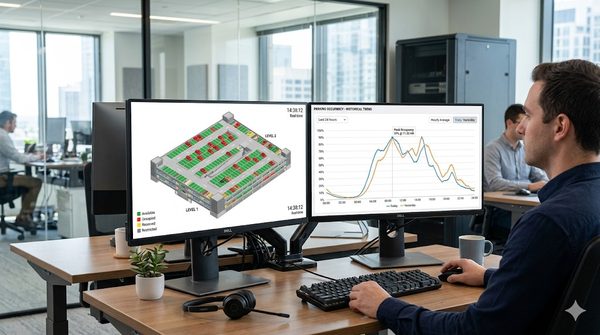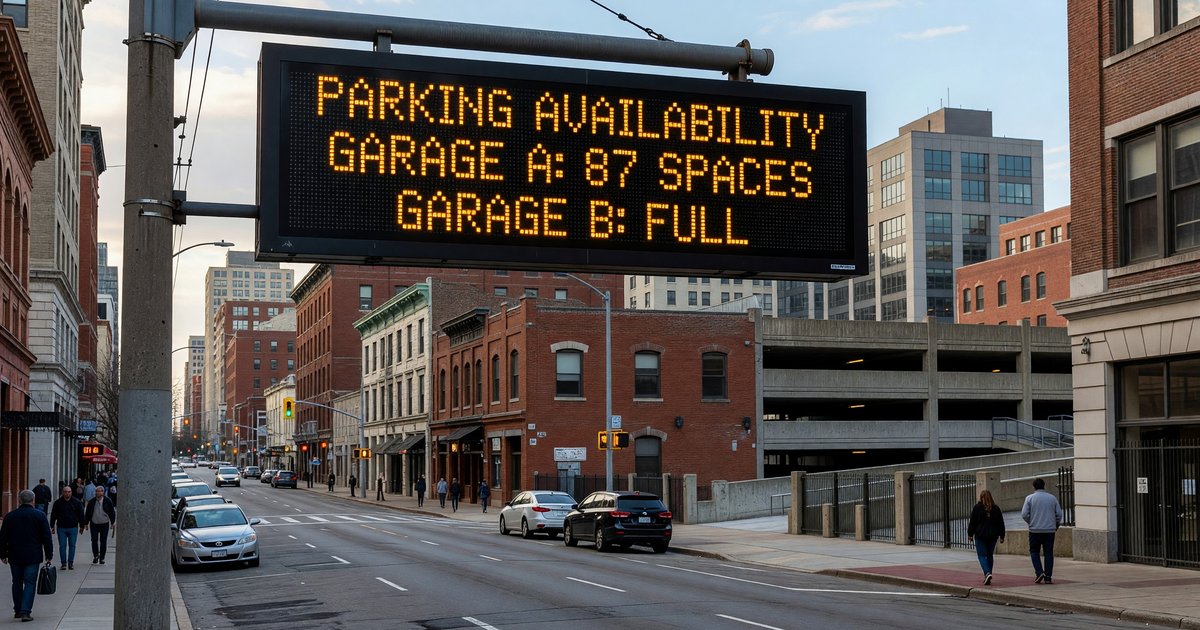
Parking guidance has existed for decades in the form of variable message signs showing available space counts. The technology has worked well enough: count vehicles entering and exiting a structure, subtract one from the other, display the number on a sign. Drivers see “24 Available” and know the structure has space.
The limitation has always been that this approach reports the past. The sign shows what was true when the last entry or exit event was recorded. In high-volume facilities during peak transitions — when a sports event ends and a concert begins, when a morning rush hour crests and transitions into midday lull — this lag between reality and reporting causes guidance failures precisely when guidance is most needed.
AI-powered parking guidance systems address this by predicting availability rather than merely reporting it. Instead of displaying what is currently known, they model what is likely to be true by the time a driver responds to the sign and reaches the facility. The result is guidance that can route drivers proactively, before a structure fills rather than after.
The Fundamental Problem With Count-Based Guidance
Traditional parking guidance relies on entry/exit event counting. Every entry increments a counter; every exit decrements it. The displayed count is the current theoretical occupancy, derived from a running tally.
This approach has three structural problems in high-volume or high-variability environments.
Processing lag. In facilities with lane-based ticketing systems, the count event registers when a ticket is pulled or a barrier arm closes — not when the vehicle enters the space. At busy entry lanes with queues, there can be a two to four minute lag between the vehicle leaving the guidance sign’s sight line and the count being updated.
No spatial distribution. A count-based system tells drivers a structure has 15 spaces, but cannot tell them that all 15 spaces are on the seventh level in a specific section. Drivers enter the structure expecting to find a space quickly and instead navigate through six full levels before finding one — a frustration that the sign technically did not cause but that still reflects poorly on the guidance system.
No anticipation of event-driven transitions. When a stadium empties and several thousand vehicles attempt to exit surrounding parking structures simultaneously, count-based systems on adjacent structures show “Available” until they are overwhelmed. There is no mechanism to anticipate the incoming demand wave and begin routing drivers away in advance.
What AI-Powered Guidance Actually Does
AI guidance systems augment or replace count-based logic with predictive models that incorporate multiple data streams.
Predictive Occupancy Modeling
Rather than displaying current occupancy, advanced systems display predicted occupancy at a future time horizon — typically 10 to 20 minutes, matching the time it takes a driver who sees a sign to navigate to and enter the facility. The model continuously updates based on current occupancy, recent entry/exit rates, event calendar data, time-of-day patterns, and weather.
The accuracy of these predictions at short horizons (10 to 30 minutes) is high enough to be operationally useful. Gradient boosted models trained on 12 to 18 months of facility data typically achieve mean absolute errors of 3 to 8 percent of total capacity at 15-minute horizons — good enough to reliably distinguish “will be full” from “will have meaningful availability.”
Multi-Facility Network Optimization
City-scale AI guidance systems manage availability messaging across a network of facilities simultaneously, optimizing for network-wide outcomes rather than individual facility occupancy. When Structure A is predicted to fill, the system increases the salience of available space messaging for Structure B, C, and D — not just by updating their counts but by adjusting the routing recommendation displayed on signs approaching the district.
This network-level optimization is where the greatest driver benefit occurs. Instead of every sign independently reporting its own structure’s status, the system choreographs messaging across the network to distribute demand before concentrations develop.
Several European cities — including Amsterdam, Barcelona, and Lyon — have operated city-scale AI parking guidance systems for over five years. Published evaluations of these programs report 15 to 25 percent reductions in average time searching for parking in instrumented districts, with corresponding reductions in parking-related traffic congestion measured at nearby intersections.
Integration With Navigation Platforms
The most impactful recent development in AI parking guidance is integration with turn-by-turn navigation applications. When a driver using a navigation app enters a destination in a district with a connected parking guidance system, the app can display real-time and predicted parking availability for nearby facilities alongside the driving directions — essentially making the parking guidance system’s intelligence available to every driver with a smartphone, not just those who happen to pass a variable message sign.
This integration is technically feasible through APIs that parking management platforms provide to navigation partners. It is commercially complex — different cities and operators have different relationships with navigation platform providers — but the deployment trend is clearly toward deeper integration. The Federal Highway Administration has supported several connected infrastructure pilot programs that include parking guidance data sharing with navigation platforms, documented through the ITS Joint Program Office at its.dot.gov.
Infrastructure Requirements
Sensor Coverage
AI guidance systems require denser and more accurate occupancy data than count-based systems. Entry/exit counters alone are insufficient — the AI needs to know where in a structure vehicles are, not just how many. This typically requires either per-space sensors (magnetometers, ultrasonic, or LiDAR depending on the structure type) or zone-level camera coverage that can provide floor-by-floor or section-level availability.
Per-space sensor data also feeds the AI’s spatial distribution capability — enabling guidance signs to indicate not just “spaces available” but which level or section, reducing the frustration of finding spaces that exist but are hard to reach.
Communication Infrastructure
Real-time AI guidance requires continuous bidirectional data flow: sensor data flowing to the processing platform, and guidance updates flowing back to signs and mobile interfaces. Latency requirements are modest — updates at 30-second to 2-minute intervals are sufficient for most guidance applications — but reliability is essential. A guidance system that goes dark during peak demand is worse than no guidance system, because it creates uncertainty.
Most modern implementations use wired Ethernet backhaul for variable message signs (chosen for reliability) combined with cellular or Wi-Fi connectivity for mobile app data delivery.
Data Platform and Integration
The AI processing layer requires a platform that ingests sensor data, applies the prediction model, manages event calendar integration, and pushes output to guidance endpoints. This is typically a cloud-hosted software-as-a-service platform from a specialized parking technology vendor, though large municipal programs sometimes operate on-premise infrastructure.
Integration with the parking payment and access system is important for accuracy: payment events confirm exits in a way that exit sensor counts sometimes miss (tailgating, sensor malfunction), and payment data provides ground truth for model validation and retraining.
Evaluating AI Guidance System Claims
The parking technology market has a well-established pattern of marketing inflation. “AI-powered” can mean a sophisticated predictive model or a rule-based threshold system with a new label. When evaluating vendor claims, focus on a few specific questions.
What is the prediction horizon? Systems that predict 30 seconds ahead are essentially real-time; systems that predict 15 to 30 minutes ahead are genuinely useful for proactive guidance.
What data does the model use? A system that only uses current occupancy counts is a more sophisticated version of traditional guidance, not a fundamentally different approach. Genuine AI guidance incorporates event calendars, weather, time-pattern modeling, and ideally external signal data.
Can you see the accuracy metrics? Ask for mean absolute error on 15-minute and 30-minute predictions from a production deployment. Vendors with confident accuracy claims should be willing to share this data.
What happens when the model is wrong? Every predictive system is wrong sometimes. How does the system handle edge cases — events not in the calendar, unexpected closures, system failures — and how quickly does it recover?
The National Association of City Transportation Officials has published frameworks for evaluating smart parking systems in an urban context, useful for procurement teams building evaluation criteria, available at nacto.org.
Where AI Guidance Delivers the Best ROI
Not every parking context benefits equally from AI-powered guidance. The strongest ROI cases share common characteristics.
High-variability demand environments. Facilities near stadiums, convention centers, entertainment districts, and transit hubs experience demand swings that predictive models are well-positioned to handle. Facilities with highly predictable, stable demand patterns see less marginal benefit from prediction versus counting.
Multi-facility districts. The network optimization capability of AI guidance only delivers value when there are multiple facilities to distribute demand across. Single facilities in isolated locations see the smallest benefit from the predictive layer.
High driver cruising rates. In districts where parking-related traffic is a meaningful fraction of total vehicle traffic, the congestion reduction benefit of better guidance extends beyond driver convenience to overall traffic management. Cities with measured parking-related VMT exceeding 15 to 20 percent of total urban VMT have the strongest ROI case for AI guidance investment.
Mobile-first markets. The value of AI guidance is amplified when it reaches drivers through navigation integration rather than only through fixed signs. Markets with high smartphone penetration and high navigation app usage extract more value from AI guidance systems that have mobile delivery capability.
AI-powered parking guidance is not a replacement for good facility design, clear signage, and adequate supply. But in the environments where parking demand is genuinely complex and variable, predictive guidance creates measurable improvements in driver experience, congestion, and facility utilization that count-based systems cannot match. The technology is ready; the question is whether operators and cities are willing to invest in the data infrastructure required to make it work.
See also: Parking Guidance Systems: An Operator’s Evaluation Guide and our analysis of ML-based parking demand forecasting for the analytics layer that powers predictive guidance.
Frequently Asked Questions
How does AI parking guidance differ from traditional variable message signs?
Traditional guidance systems count vehicles entering and exiting to calculate current occupancy and display it on signs. AI guidance systems predict future occupancy by incorporating event calendars, historical patterns, weather, and real-time sensor data — displaying what availability is likely to be when a driver arrives, rather than what it was when the count was last updated. This distinction is most valuable during high-demand transitions when traditional counts lag reality.
What data sources do AI parking guidance systems use?
Most AI guidance systems combine real-time occupancy sensor data (per-space or zone-level) with event calendar data, time-of-day and day-of-week patterns, weather forecasts, and entry/exit rate trends. Advanced implementations also incorporate navigation app query volumes, transit system status, and nearby rideshare demand data. The breadth of input data is a key differentiator in model accuracy.
Can AI parking guidance integrate with smartphone navigation apps?
Yes — many modern AI parking guidance platforms provide APIs that navigation apps (such as Google Maps, Apple Maps, and Waze) can use to display real-time and predicted parking availability directly within turn-by-turn directions. This integration is the most impactful delivery mechanism, reaching every driver with a smartphone rather than only those who pass a fixed variable message sign.
What accuracy should operators expect from AI parking guidance predictions?
At a 15-minute prediction horizon, well-trained models typically achieve mean absolute errors of 3 to 8 percent of total capacity — accurate enough to reliably distinguish between “will be full” and “significant availability.” Accuracy degrades at longer horizons and improves with more historical training data. Ask vendors for production accuracy metrics, not benchmark numbers from controlled test environments.
How much does an AI parking guidance system cost compared to traditional guidance?
AI guidance systems carry higher initial cost than traditional count-based systems, primarily because they require per-space or zone-level sensors (not just entry/exit counters), more sophisticated software platforms with ongoing subscription fees, and deeper integration with event calendars and external data sources. The cost premium varies by facility size, but operators typically pay 30 to 60 percent more for AI-capable platforms than for basic count-based guidance. The ROI case depends on the volume and variability of the facility’s demand.
Are AI parking guidance systems used in cities today?
Yes — city-scale AI parking guidance systems have been operating in European cities including Amsterdam, Barcelona, and Lyon for over five years. In North America, several major cities including San Francisco, Los Angeles, and Chicago have deployed elements of AI-informed parking management in specific districts. The U.S. Department of Transportation has funded connected parking pilot programs in multiple cities through the ITS Joint Program Office.
Further Reading From Authoritative Sources
- ITS Joint Program Office — Connected Parking Infrastructure: The U.S. DOT’s ITS JPO documents connected infrastructure programs including parking guidance data integration with navigation platforms and connected vehicle infrastructure.
- NACTO — Parking and Curb Management Guidance: The National Association of City Transportation Officials publishes frameworks for evaluating and deploying smart parking and curb management systems in urban environments.