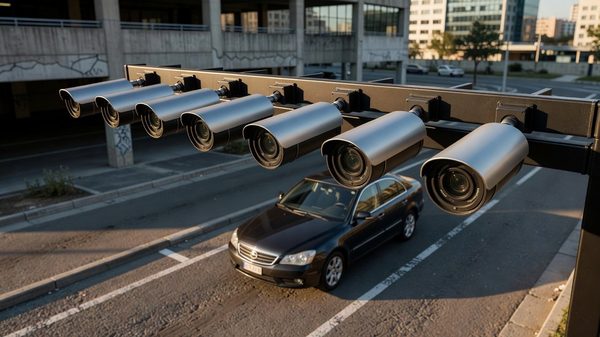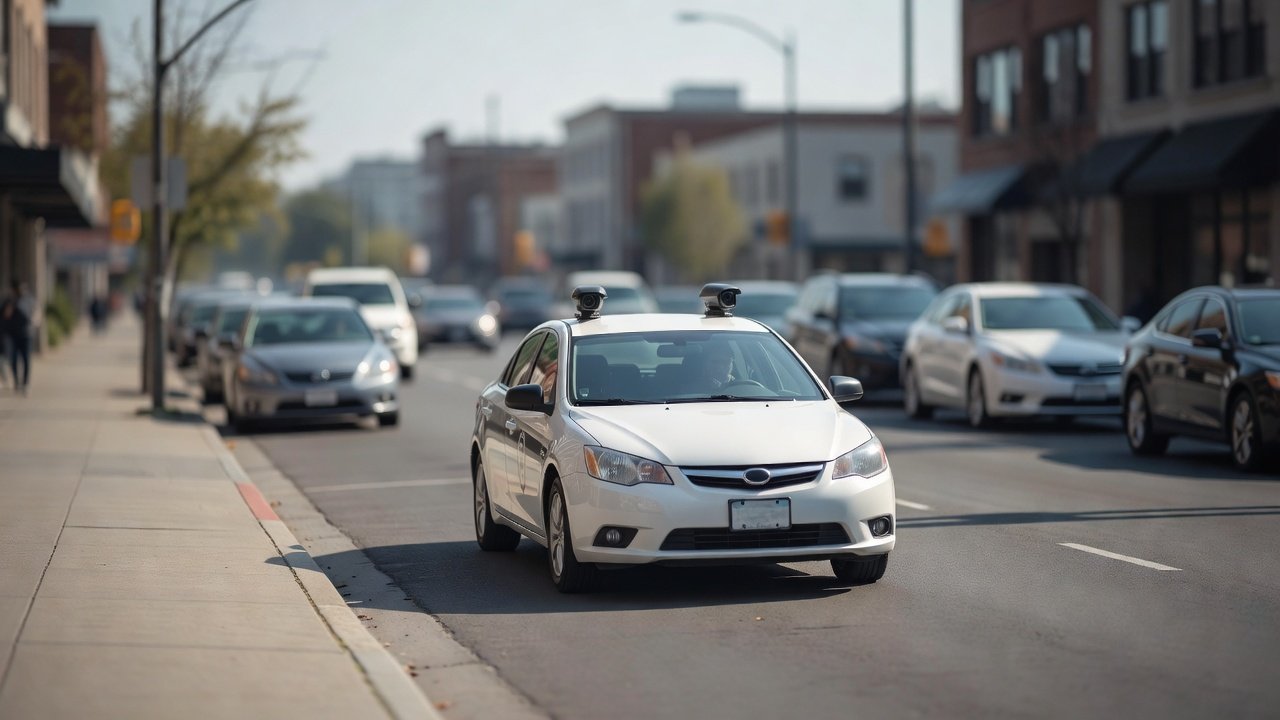
Parking enforcement used to depend on an officer walking a route with a handheld device and the discretion to let a driver off. Cameras on vehicles change that arithmetic. A car or bus fitted with a plate reader and an AI model can scan far more kerb in a shift than a person on foot, flag what looks like a violation, and mail the evidence days later. The coverage is the selling point and the source of most complaints.
The one published pilot with real numbers
The clearest public data comes from AC Transit in California’s East Bay, which fitted buses with forward-facing cameras to catch vehicles in bus stops. Its figures, reported by GovTech in 2024, compare the same five-week window (June and July) in two years:
- In 2023, under a manual system that needed camera activation, the pilot documented 879 violations and 22 citations resulted.
- In 2024, on buses upgraded with AI hardware and software, it documented 1,102 potential violations and 787 resulted in citations.
Read carefully, that is a throughput result, not an accuracy result. About 71% of flagged events became citations, which says that a large share survived review, but it does not say how many of the other 29% were false alarms, how many were duplicates, and how many were dropped for other reasons. The article gives no false-positive rate. The 2023 comparison also differs from the 2024 setup in more than the AI, so the jump from 22 to 787 should not be credited to the model alone.
The review step is the safeguard. At AC Transit, Alameda County Sheriff’s Department staff review the evidence and decide whether to issue a citation to the registered owner. The agency also started with two months of warning notices before the $110 citation took effect on 7 October 2024.
Humans stay in the loop, by design
Hayden AI, whose bus-mounted systems operate in New York, Washington DC, Oakland and Los Angeles and have been piloted in several European cities, describes the same pattern. A context camera records a 10-second evidence package when it detects a violation, and a second camera photographs the plate. According to Next City’s reporting, a human reviews every evidence package before it becomes a notice. The vendor does not publish a false-positive rate.
Outcome claims come from the operators, not from independent audits. New York’s MTA reports bus speeds up 5%, collisions down 20% and emissions down by up to 10%, and reports that over 90% of ticketed drivers do not receive a second ticket. A separate account puts the repeat-offence figure at 86%. The gap between those two numbers is itself a caution: the claims are measured differently, and nobody outside the programme has reproduced them. A 2023 SEPTA pilot recorded 36,000 violations over 70 days on two bus lines, which shows how much blocking there is, not how well the system classifies it.
Where privacy rules are written down
Privacy controls vary by agency, and they are usually written into the programme, not the technology. AC Transit states that its cameras do not capture the inside of the bus and are angled toward vehicles in the bus lane. Images with no violation must be destroyed within 15 days. Violation images must be destroyed within six months unless the citation is disputed. The agency says there is no facial recognition or other biometric detection.
Hayden AI says its system does not continuously record or stream video and only saves footage when it detects a violation. It also says it can blur faces and obscure plates, a feature European cities have asked for. According to its chief technology officer, quoted by Next City, US agencies have been wary of blurring because it could be read as altering evidence.
Pittsburgh shows a different model. The city’s parking authority runs enforcement cars and pole-mounted scanners, and told CBS Pittsburgh in December 2025 that it does not keep the digital data or share it with law enforcement. The report did not independently verify those statements. Retention limits, data-sharing bans and audit rights deserve to be public documents, not assurances given to a reporter.
Why the backlash is not only about privacy
Complaints in the coverage cluster in three places.
Discretion. Pittsburgh’s authority issued 226,000 tickets through September 2025 against 177,000 a year earlier, with revenue of $8.7 million against $7.2 million. About 110 cameras now monitor bike lanes and flag vehicles stopped for more than 90 seconds. CBS reported a ride-share driver ticketed for a drop-off at a hospital, who had to appeal in traffic court. Drivers say a machine cannot weigh a stopped car with its hazards on against a delivery in progress.
Revenue motive. When ticket volume and revenue rise together, residents assume the programme exists to raise money. A University of Pittsburgh law professor quoted by CBS framed the wider concern as growing surveillance and called for limits on camera proliferation.
Mission creep. Systems bought to clear bus lanes are now pitched for bike lanes, loading zones and paratransit stops. Each extension changes the rules a driver thought they were agreeing to, and public support for bus-lane enforcement does not automatically carry over.
What operators and cities should require
Anyone buying or approving a vehicle-mounted system can ask for specifics before the cameras roll:
- Measured accuracy. Ask for the share of AI-flagged events rejected at human review, broken down by violation type and route, and for how that figure is audited.
- Review of every notice. Confirm that no citation is issued without a person reviewing the evidence, and record reviewer decisions so the model can be checked.
- Retention in writing. Set deletion periods for non-violation images and violation images, with a ban on secondary use and sharing, and publish them.
- A grace period. Start with warnings, as AC Transit did, so drivers learn the rules before paying.
- Plain appeal rights. Put the evidence package, the rule applied and the appeal route on every notice.
- Scope control. Require a public decision before adding violation types or locations.
The technology has shown it can find more violations than a manual process. What it has not shown, in any source reviewed here, is an independently verified error rate. Cities that publish one, and accept outside scrutiny of it, will earn a licence to expand.