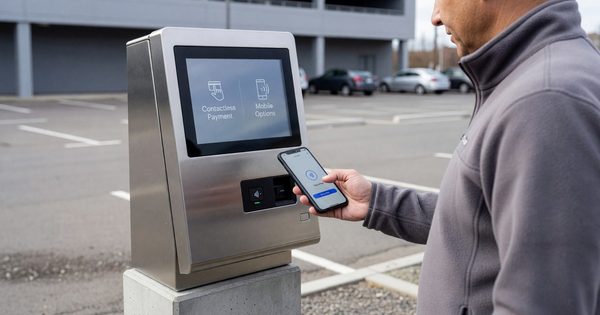
Smart parking systems are data systems. A modern parking facility equipped with LPR cameras, per-space sensors, mobile payment apps, and a connected management platform generates a continuous stream of data about every vehicle that enters and exits the facility: when it arrived, how long it stayed, where in the facility it was located, what payment method was used, and — through license plate records — who owns the vehicle.
For most of parking’s history, this information existed only in paper records, magnetic stripe logs, and the memory of attendants. It was practically difficult to aggregate and nearly impossible to exploit at scale. That constraint no longer exists. Modern parking data platforms can store, analyze, and share parking session data at industrial scale, creating obligations — legal, operational, and reputational — that many parking operators have been slow to address.
This article examines the data privacy and cybersecurity issues that smart parking operators face, what the regulatory landscape requires, and what practical steps operators should take to manage these risks.
What Data Smart Parking Systems Collect
Understanding the obligation starts with understanding what is actually collected. Smart parking systems collect several categories of data that carry privacy implications.
License Plate Data
License plate recognition cameras capture images of every vehicle entering and exiting the facility. From those images, LPR software extracts plate characters and links them to session records. The plate number, combined with state DMV records (in jurisdictions where plate-to-owner linkage is available), identifies the vehicle’s registered owner.
Aggregated over time, LPR records create a detailed location history for every vehicle that uses the facility: arrival and departure times, visit frequency, dwell patterns. This is individually identifying information about real people’s movements — the kind of data that privacy law increasingly treats with heightened sensitivity.
Payment Credentials and Transaction Records
When a driver pays through a mobile app or a pay station with card payment, transaction data is created: payment method, amount, timestamp, and session identifier. This data is subject to Payment Card Industry Data Security Standard (PCI DSS) requirements when card data is involved, and to broader financial privacy frameworks in some jurisdictions.
Payment records combined with LPR records create a linkage between a financial identity and a physical location history.
Behavioral and Pattern Data
Parking management platforms aggregate session data across time to produce behavioral analytics: which vehicles are frequent users, what time patterns they exhibit, how long they typically stay. This pattern data, while derived from transaction records, can constitute a separate privacy-sensitive dataset — it reveals habits and routines in ways that individual transaction records do not.
Camera and Video Feeds
Facilities with camera-based occupancy detection or security camera coverage generate continuous video data that may capture individuals as well as vehicles. Video data raises specific privacy obligations in many jurisdictions, particularly when stored for extended periods or shared with third parties.
The Regulatory Landscape
Privacy regulation affecting parking data has evolved rapidly and continues to evolve. Operators need to be aware of obligations at multiple levels.
State Privacy Laws in the United States
The United States does not have a federal comprehensive data privacy law, but a growing number of states have enacted their own. California’s Consumer Privacy Act (CCPA) and its successor, the California Privacy Rights Act (CPRA), establish rights for California residents to know what personal data businesses collect, to request deletion, and to opt out of sale of their data. Similar laws are now in effect in Virginia, Colorado, Connecticut, Texas, and other states, with more pending.
For parking operators, these laws create compliance requirements if they collect personal data from residents of these states — which effectively means any operator serving a significant volume of customers in these markets.
Specific to license plate data: several states have enacted statutes governing LPR data retention and use that are more restrictive than general privacy law. Texas, for example, limits how long LPR data can be retained by private operators and restricts sharing with third parties. Operators in states with LPR-specific statutes need legal review of their data practices for each affected jurisdiction.
The U.S. Department of Transportation has published guidance on connected vehicle and transportation data privacy through its ITS Joint Program Office, accessible at its.dot.gov, which provides context for understanding federal approaches to transportation data governance.
GDPR and International Frameworks
Operators serving European markets, or processing data of European residents, are subject to the General Data Protection Regulation (GDPR). GDPR requirements include lawful basis for data processing, data minimization (collecting only what is necessary), defined retention limits, and data subject rights (access, rectification, erasure). GDPR violations carry potential fines of up to 4 percent of global annual turnover.
In the parking context, GDPR applies to: LPR systems capturing images of vehicles owned by EU residents, mobile payment accounts of EU residents, and any data transfer to third parties (including cloud platforms operating outside the EU) that does not comply with GDPR transfer mechanisms.
Cybersecurity Risks in Connected Parking Systems
Data privacy obligations require preventing unauthorized access to collected data — which is a cybersecurity problem as much as a legal one.
Attack Surface of a Connected Parking System
A modern parking management system includes: IoT sensors (per-space or zone-level), a network of cameras, edge compute hardware, cloud management platforms, API connections to payment processors, connections to mobile applications, and interfaces for operator access. Each of these represents a potential entry point for unauthorized access.
IoT devices in parking environments are particularly vulnerable. Sensors and cameras are often deployed with default or weak credentials, receive infrequent firmware updates, and operate on networks with limited security monitoring. The Mirai botnet — which recruited hundreds of thousands of poorly secured IoT devices in 2016 — included parking and traffic devices among its targets.
Data Breach Consequences
A breach of a parking operator’s LPR database is not a hypothetical minor incident. Depending on the database’s scope, it can expose the location histories of thousands of vehicles and their owners. If payment data is included, financial fraud liability follows. Notification obligations — to affected individuals, to state attorneys general, sometimes to federal regulators — apply in most U.S. states and internationally under GDPR.
The reputational consequence of a parking data breach, particularly one involving LPR data, can be severe. License plate location data is intuitively understood by the public as sensitive personal information, and media coverage of parking data breaches has been significant.
Vendor Security Assessment
For most parking operators, cybersecurity is largely a vendor selection and contract management problem. The operator cannot secure every sensor and platform independently — they depend on vendors to deliver secure hardware and software. This makes vendor security assessment critical.
Operators should require vendors to provide: SOC 2 Type II reports (or equivalent third-party security audit results) for cloud platforms; documented software update policies and security response procedures; data handling agreements specifying how vendor platforms process, store, and protect customer data; and clear terms around data breach notification timelines and responsibilities.
The National Institute of Standards and Technology cybersecurity framework provides a structured approach to evaluating third-party vendor security practices, available at nist.gov. The framework is widely used in transportation sector security assessments.
Practical Privacy Governance for Parking Operators
Data Minimization
The simplest privacy risk reduction strategy is collecting less data. For each data category, operators should ask: is this data necessary for the operational objective? What is the minimum retention period that serves the legitimate purpose?
For LPR data, many operational purposes (occupancy guidance, enforcement verification) are served by retaining records for 30 to 90 days. Retaining LPR records indefinitely creates perpetual privacy risk with no operational benefit. Defined retention schedules — implemented through automated deletion — are both good privacy practice and a legal compliance mechanism.
Data Use Limitation
Data collected for one purpose should not be repurposed without clear legal basis. LPR data collected for enforcement purposes should not be used for marketing analytics without the driver’s consent. Payment data collected for transaction processing should not be shared with data brokers. These are not merely ethical positions — in most privacy regimes, they are legal requirements.
Operators who monetize parking data through third-party sharing arrangements — selling aggregated or individual-level data to insurers, data brokers, or analytics companies — face the highest legal exposure and should conduct detailed legal review before pursuing these revenue streams.
Transparency and Driver Notice
Drivers who use smart parking facilities have a right to know what data is being collected about them. This requires clear notice — on signage at facility entry, in mobile app terms, and in a published privacy policy — that describes data collection practices and driver rights.
Notice that is buried in fine print or posted on an obscure privacy policy page that no reasonable person would find does not satisfy the spirit of transparency requirements and increasingly does not satisfy the letter of them either.
Incident Response Planning
Every operator with connected systems should have a documented incident response plan covering: detection of a security breach, containment steps, assessment of what data was compromised, notification obligations and timelines, and post-incident remediation. Operating without a documented incident response plan is no longer acceptable given the regulatory obligations around breach notification.
The combination of rapidly expanding data collection capabilities and rapidly expanding regulatory obligations means that parking operators who treat data privacy as a compliance afterthought rather than a design consideration will face increasing legal, financial, and reputational exposure. The operators who build privacy and security governance into their operations now — defining what data they collect, why, for how long, and with what protections — will be better positioned as the regulatory landscape continues to tighten.
See also: IoT Parking Sensors: Lessons From Real-World Deployments for the sensor context, and LPWAN vs. Cellular Parking IoT Connectivity for the network security considerations specific to parking IoT infrastructure.
Frequently Asked Questions
What personal data do smart parking systems collect?
Smart parking systems typically collect license plate images and character data (which can be linked to vehicle owners through DMV records), payment credentials and transaction records, session timestamps and dwell duration, vehicle location within the facility, and in some cases behavioral patterns derived from aggregated session history. Camera-based systems may also capture incidental images of individuals near vehicles.
What privacy laws apply to parking operators collecting LPR data?
Applicable law depends on jurisdiction. In the United States, state privacy laws (CCPA/CPRA in California, VCDPA in Virginia, and equivalents in other states) may apply to personal data including LPR records. Several states — including Texas — have enacted LPR-specific statutes with retention and use restrictions. European operations are subject to GDPR. Operators should conduct legal review for each jurisdiction they serve rather than assuming a single compliance framework covers all markets.
How long should parking operators retain LPR data?
Retention periods should be the minimum necessary for the operational purpose. For enforcement verification, 30 to 90 days is typically sufficient. For payment dispute resolution, 90 to 180 days may be appropriate. Indefinite retention creates ongoing privacy risk with no operational justification and increases legal exposure under data minimization requirements in most privacy frameworks. Automated deletion at the end of defined retention periods is best practice.
What cybersecurity risks are specific to parking IoT systems?
IoT sensors and cameras are frequently deployed with default or weak credentials and receive infrequent security updates, making them attractive targets for network intrusion. The broad attack surface of a connected parking system — sensors, cameras, edge compute, cloud platforms, payment APIs, mobile apps — provides multiple potential entry points. A breach of an LPR database exposes vehicle location histories that constitute sensitive personal information with significant breach notification obligations.
Can parking operators sell driver data to third parties?
Legally, the answer varies by jurisdiction and data type. Many privacy frameworks require explicit consent for selling personal data to third parties, or prohibit it for certain categories of sensitive data (including precise location histories). LPR-linked location data is particularly sensitive. Operators who monetize parking data through third-party sharing face significant legal exposure in most U.S. states and under GDPR in European markets and should conduct detailed legal review before pursuing these arrangements.
What should operators look for in vendor security assessments?
Key evaluation criteria: SOC 2 Type II reports for cloud platform vendors; documented software update and security patch policies; data handling agreements specifying how vendor systems process and protect customer data; breach notification procedures and contractual timelines; data retention and deletion capabilities; and encryption standards for data at rest and in transit. Operators dependent on vendor security cannot manage cybersecurity risk without these contract-level commitments.
Further Reading From Authoritative Sources
- NIST Cybersecurity Framework: The National Institute of Standards and Technology provides widely adopted cybersecurity frameworks that apply to connected parking infrastructure security assessments, vendor evaluations, and incident response planning.
- ITS Joint Program Office — Transportation Data Privacy: The U.S. DOT’s ITS Joint Program Office addresses data privacy in connected transportation systems, providing guidance relevant to parking operators deploying LPR and connected vehicle infrastructure.