The parking industry has accumulated credentials over the past twenty years: RFID transponders, hang tags, mobile app QR codes, NFC tap-to-pay, magnetic stripe tickets. Each solved an immediate problem and created a layer of infrastructure that now coexists uneasily with the others. The result in most multi-modal parking facilities is a stack of access control systems, payment terminals, and now EV charger management platforms that share no common identity layer.
License plate recognition is the candidate that makes the most operational sense as the unifying token. The plate is already on every vehicle, machine-readable from a distance, and — unlike RFID transponders or mobile apps — requires no action from the driver. The question is no longer whether LPR can serve as an identity layer across access, payment, and charging. The question is how operators architect the integration and what the failure modes are.
From Access Control to Identity Platform
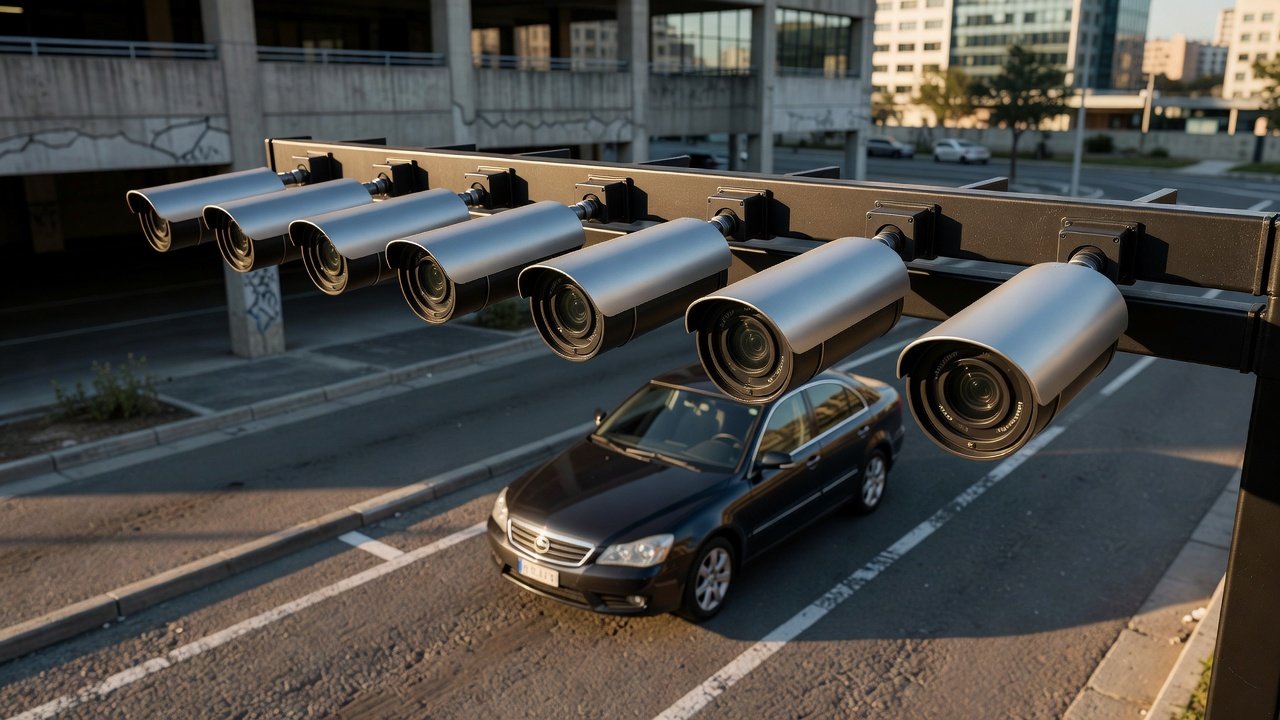
LPR systems in parking started as access control tools: cameras at entry points read plates, matched them against permit databases, and opened gates. The business case was straightforward — eliminating ticket dispensers, reducing attendant labor, and enforcing permit compliance without manual plate-checking.
The transition to identity platform begins when the same plate read that opens the gate also determines the parking session’s billing parameters. Pay-by-plate systems tie the license plate directly to a payment transaction: entry timestamp, exit timestamp, applicable rate, and charge to a linked payment method — all resolved against the plate as the primary key. The driver’s interaction with the payment system happens outside the facility (registration via app or web portal) or at a pay station that records the plate and collects payment, not at a barrier that requires a ticket to exit.
Institutions that have made this transition report consistent operational benefits. The University of Michigan implemented a virtual permit system based on LPR in 2025-2026, eliminating physical hang tags and decal permits across their Ann Arbor campus. Gates are now triggered by plate match against a database of authorized permits, with no physical credential required in the vehicle.
Commercial operators running LPR-based pay-by-plate systems describe reduced drive-offs (no exit ticket to lose), lower equipment maintenance costs (no ticket dispensers or readers to service), and shorter average exit processing times since there is no mechanical ticket transaction.
How EV Charger Authentication Closes the Loop
EV charger authentication is where the unified identity model moves from convenient to structurally significant. Current charger authentication relies on one of three mechanisms: RFID card/fob, smartphone app (including Plug & Charge protocols per ISO 15118), or network account activation. Each requires a separate credential from the parking access credential.
LPR-based charger authentication eliminates that separation. When an EV enters a parking facility using plate-based access, and the facility’s parking management software ties that plate to a registered account, the charger management system can verify the same plate against the same account database when the vehicle plugs in. The charger activates based on the plate read at plug-in, the session is billed to the account linked to that plate, and the parking and charging transactions are settled together at exit.
The technical implementation requires that the parking management software and the EV charger management system share a common identity database — or expose APIs that allow real-time cross-system verification. This integration is available from vendors who offer both parking and charging management in a single platform; it requires custom integration work when the two systems come from different vendors.
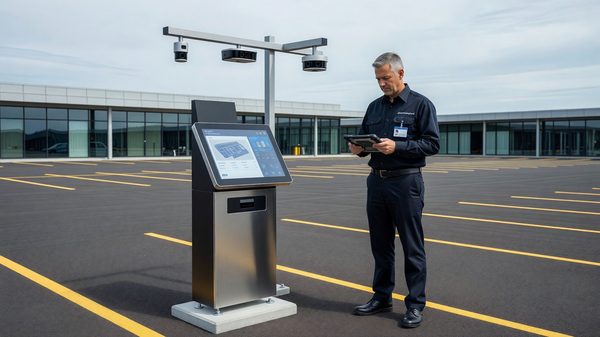
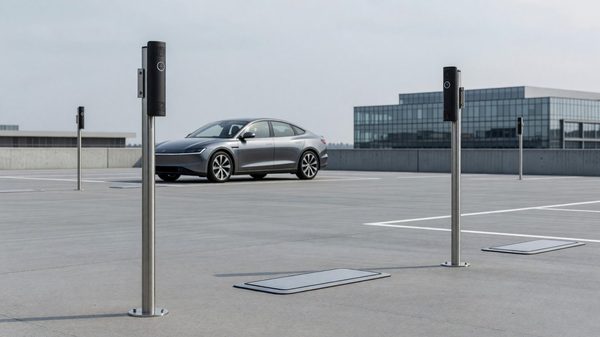
The practical constraint is camera positioning. A charger authentication read requires a camera positioned to reliably capture the plate of a vehicle that is stationary in a stall, often in a covered garage environment with mixed lighting. Entry-point cameras positioned for moving vehicles at barrier speed are not the same as stall-level cameras designed for dwell authentication. Operators specifying LPR-based EV authentication need both camera types — entry/exit cameras for the access and payment layer, and stall-level cameras or column-mounted units for charger authentication.
The Permit, Payment, and Charging Database
The architectural question that determines whether plate-as-universal-token works at a given facility is whether the three underlying systems — access control, payment processing, and EVSE management — can share or synchronize a common vehicle database in real time.
In a fully integrated platform, this is straightforward: one software system manages all three functions with a single vehicle record containing the plate number, payment method, permit type (if any), and EV charging authorization. When the plate is read at any touchpoint, the single record resolves all relevant parameters.
In the more common multi-vendor environment, integration is achievable through APIs but requires ongoing maintenance as each vendor updates their platform. The key requirement is that the plate match query must return an authoritative response in under 500 milliseconds — fast enough to open a gate without detectable delay, and fast enough to activate a charger before the driver gives up and assumes the system failed.
For operators with older parking management software that lacks modern API architecture, the unified plate token model may require a software upgrade or replacement before it is achievable. This is a real constraint that vendors marketing LPR integration don’t emphasize: the camera hardware is the straightforward part. The database architecture that makes the plate meaningful across all three applications is where the integration work actually lives.
Rate Differentiation and Session Management by Plate Class
Once the plate is established as the identity layer, facilities can implement rate and access differentiation that was previously impractical. A parking facility that distinguishes between monthly permit holders, transient parkers, EV charging sessions, and commercial vehicles now has a single point of identification — the plate — at which that classification can be applied.
Practical applications that operators are implementing:
EV-priority stall enforcement. Camera systems that read stalls continuously can identify non-EV vehicles occupying EV-designated stalls and flag them for enforcement, without requiring a physical permit or attendant verification.
Dynamic pricing by vehicle class. Plate reads tied to vehicle registration data can distinguish passenger vehicles from commercial vans, enabling differential rate application at exit without a separate commercial vehicle designation process.
Session linkage for validation and comp programs. A business that validates parking for customers can extend that validation to the EV charging session associated with the same plate, settling both components against the validated transaction. This requires that validation systems interface with the unified plate database rather than only the parking payment system.
Overstay detection in EV stalls. Facilities with charging stalls that carry time limits (90 minutes maximum, for example) can use stall cameras to detect vehicles that remain plugged in after their charging session ends, and generate enforcement notices or automated surcharges against the registered plate account.
None of these applications are technically novel — they follow directly from treating the plate as the primary key in a unified database. The operational improvement over credential-fragmented systems is the elimination of edge cases: no RFID card left at home, no app that fails to connect, no ticket lost in the seat cushion.
Where the Model Breaks Down
The unified plate token model has failure modes that operators should understand before committing to it as their primary authentication layer.
Rental vehicles and temporary plates. Rental fleets rotate plates across vehicles continuously, and temporary paper plates are a recognized fraud vector in LPR systems. A unified plate database that relies on pre-registration creates gaps for transient users who haven’t pre-registered and for vehicles whose plates don’t match the registration database in real time. The standard operational response is maintaining a pay-station fallback for unregistered plates — the system defaults to traditional pay-by-plate manual entry for vehicles that don’t match a registered account.
Plate obstruction and damage. Dirty, bent, or partially obscured plates create false negatives or misreads. Modern LPR systems with infrared illumination and multi-angle capture reduce error rates significantly, but facilities operating in high-snow or high-dust environments see elevated error rates. Reported accuracy rates for well-maintained systems in favorable conditions run 95 to 99 percent; adverse conditions can drop this to 85 to 90 percent, which is insufficient for a gate-opening or charger-activation application without a fallback mechanism.
Privacy and data retention obligations. A unified plate database that ties plate numbers to payment accounts, dwell histories, and charging sessions is a significant personal data asset. Several US states — California, Virginia, Colorado, and others — have enacted data privacy regulations that treat vehicle location and identity data as personal information subject to data subject access and deletion rights. Operators maintaining unified plate databases need a documented data retention and deletion policy that complies with applicable state privacy law, and need to communicate that policy to drivers at the point of pre-registration.
Cloned plates. A known fraud technique involves affixing a copied plate to a different vehicle to access facilities with plate-based access control. Detection requires cross-referencing plate data against vehicle make and model information from DMV records or from camera-based vehicle classification. Operators in high-fraud-risk markets (airports, high-value urban garages) should supplement plate authentication with vehicle classification matching to reduce this exposure.
The Convergence Already Happening
The practical convergence of parking access, payment, and EV charging authentication onto a single plate-based identity layer is underway at scale — not in pilot programs, but in production deployments at universities, airports, and commercial facilities that have replaced fragmented credential systems with integrated LPR platforms.
The infrastructure investment required is predominantly software integration and camera hardware, not structural work. The operational return — reduced equipment maintenance, lower per-transaction processing costs, and the ability to offer differentiated services by vehicle class — justifies the integration cost in most mid-to-large facility settings.
Operators who treat LPR as a gate access tool are running a fraction of the system’s available function. The plate is already being read at entry. The question is whether the software behind the camera is sophisticated enough to use that read across every application the vehicle touches during its time in the facility.
Further Reading
- T2 Systems — LPR Parking Enforcement — operational overview of plate-based enforcement
- SKIDATA — Streamline Parking Operations with LPR — operator-focused integration guide
- Nature Scientific Reports — IoT-Integrated Parking with LPR and Payment Management — research on integrated IoT parking systems
- HUB Parking Global — LPR Systems — multi-site LPR deployment architecture