Parking payment has historically been a laggard in financial technology. While retail, transit, and food service moved through successive waves of payment innovation — credit cards, contactless tap, mobile wallets, peer-to-peer transfers — many parking operations remained tethered to coin mechanisms, magnetic stripe cards, and paper ticket validation systems well into the 2020s.
That lag is closing rapidly. The intersection of mobile connectivity, license plate recognition, and cloud-based payment infrastructure is producing parking payment experiences that are qualitatively different from what existed even five years ago. For some operators and some drivers, parking payment has become genuinely frictionless. For others, it remains a fragmented, equipment-dependent process that creates friction at every step.
Understanding the current state of parking payment technology — what works, what is still maturing, and where the integration gaps remain — is essential for operators planning equipment cycles and for city agencies setting standards for public parking operations.
The Core Architecture Shift: From Equipment-Centric to Account-Centric
Traditional parking payment architecture is equipment-centric. The pay station or gate machine is the point of transaction. Revenue flows through equipment, which must be physically collected, maintained, and reconciled. Payment options are determined by what the machine supports — if the machine doesn’t take Apple Pay, Apple Pay doesn’t work.
Modern smart parking payment architecture is account-centric. The driver has an account (in a parking app, a city mobility platform, or a license plate registration in a payment database). The account holds the payment credential. Any payment event — entry, exit, time extension, validation, citation — is handled by communicating with the account, not by interacting with a specific machine.
This shift has several important implications:
Payment method independence. When payment is account-linked, the payment method stored in the account can be any credential the account platform supports: credit card, debit card, ACH, digital wallet, prepaid balance, corporate fleet card, or even municipal benefit credits. The driver doesn’t need to carry cash or a parking-specific card.
Device independence. Payment isn’t tied to a specific device. The driver can extend a session from a phone that’s different from the one used to initiate it, or have a passenger extend while the driver stays in the vehicle.
Backend consolidation. Account-centric payment generates a clean digital record of every transaction, enabling revenue reporting, utilization analytics, and audit trails without manual reconciliation of physical cash or card batches.
Key Technology Layers in Modern Parking Payment
Mobile Pay Stations and App-Based Payment
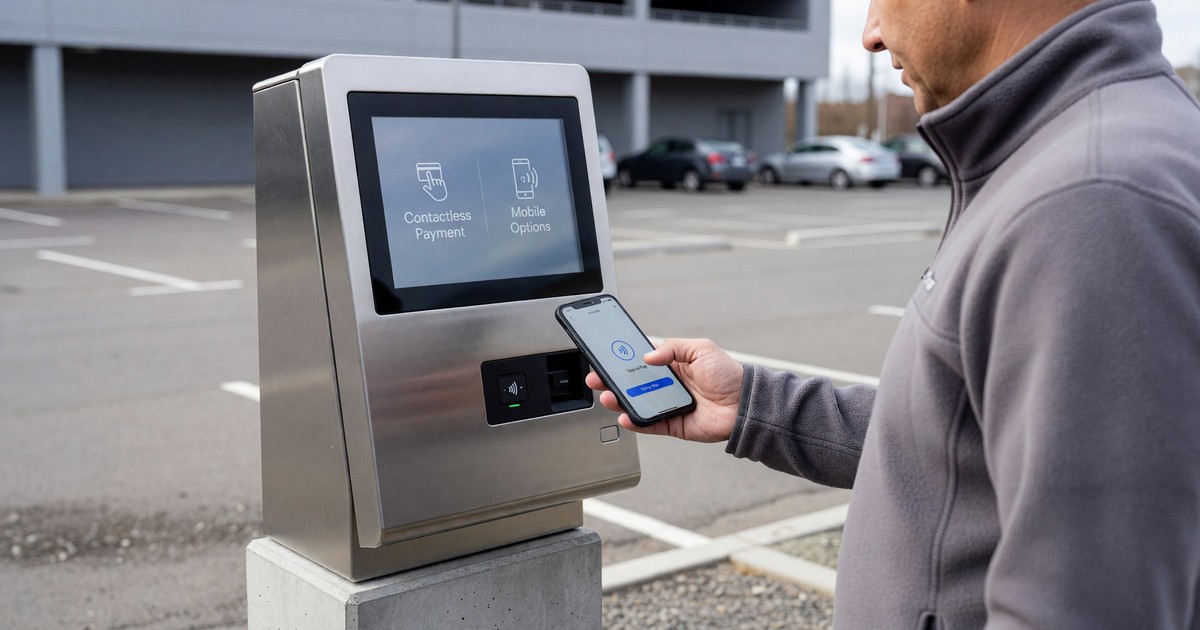
The most widely deployed innovation in parking payment over the past decade is app-based payment for on-street and surface lot parking. Services like ParkMobile, PayByPhone, and Passport enable drivers to pay via smartphone without returning to a pay station — entering a zone or space number, selecting a duration, and extending remotely.
This model has meaningful advantages over traditional pay-and-display: no risk of meter expiration when meetings run long, no requirement to guess parking duration in advance, and payment entirely through the driver’s existing smartphone payment credentials.
The limitation is friction at enrollment and initiation. First-time users must download an app, create an account, and enter payment information before they can pay — a process that takes several minutes and creates a significant abandonment rate for infrequent parkers. Subsequent sessions are faster, but the initial enrollment remains a barrier.
Some cities have addressed this through text-message-based payment (the driver texts a code and receives a payment link) or QR-code-initiated web sessions that do not require app installation. These lower the enrollment barrier at the cost of a slightly less streamlined experience for repeat users.
License Plate-Linked Payment (Pay by Plate)
Pay by plate systems link payment directly to a vehicle license plate, with the plate serving as the identifier. At entry or at a pay station, the driver enters their plate number (or it is read by an LPR camera). Payment is applied to the plate account, enabling enforcement officers to verify payment by scanning plates rather than checking paper tickets.
The advantage over traditional ticketing: no physical ticket to lose, no return to the vehicle to display a receipt, and enforcement via automatic plate scanning rather than windshield checking. For permit operations, monthly payments automatically apply to the registered plate without action from the driver.
The limitation of plate-based payment is the accuracy dependency: LPR read errors produce mismatches between payment records and enforcement scans, resulting in wrongful citations for paying customers and enforcement gaps for non-payers. System accuracy requirements for pay-by-plate are higher than for guidance applications — a 97 percent LPR accuracy rate that is acceptable for occupancy counting means 3 percent of vehicles face potential billing or enforcement errors.
Dynamic Pricing Engines
Static parking rates — a flat hourly rate or a fixed daily maximum — leave significant revenue on the table during high-demand periods and deter customers during low-demand periods. Dynamic pricing adjusts rates in real time (or near real time) based on measured or predicted demand.
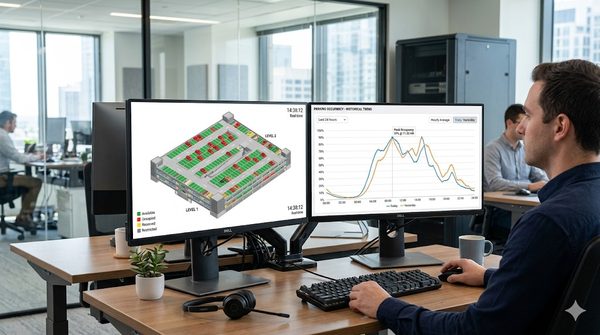
Technically, dynamic pricing requires three integrated components: real-time occupancy data (to know current demand), a pricing algorithm (to determine the appropriate rate given demand), and a payment system that can apply variable rates without manual rate card changes. The first and last components have historically been the bottlenecks.
Modern PARCS (Parking Access and Revenue Control Systems) increasingly support variable rate tables that the central management software can update remotely, enabling pricing changes in minutes rather than requiring technician visits to reprogram equipment. Cloud-connected pay stations and mobile payment platforms support dynamic rates natively.
San Francisco’s SFpark program, which ran from 2011 to 2014 and was extended in evolved form through 2018, demonstrated that sensor-informed dynamic pricing can achieve measurable improvements in availability and driver satisfaction, with documented research available through the Federal Highway Administration at fhwa.dot.gov. More recent implementations in New York, Chicago, and several European cities have built on this foundation with more sophisticated demand modeling.
Integrated Mobility Wallets
The emerging frontier in parking payment is integration with broader mobility platforms — accounts that hold payment credentials and entitlements for multiple transportation modes: transit passes, bike share memberships, rideshare credits, and parking. The concept is a single account through which a traveler manages all urban mobility spending.
Several cities have deployed early versions of integrated mobility accounts, typically through city-sponsored mobility-as-a-service (MaaS) platforms. Parking is often the last mode to integrate due to the fragmentation of parking operators and payment systems, but integration is progressing.
For operators, the practical implication is that their payment platform needs to be capable of accepting payment tokens from external MaaS wallets — a technical requirement that affects procurement decisions. Operators who lock themselves into proprietary payment ecosystems with no third-party wallet support will be incompatible with city-sponsored integration programs.
Validation and Merchant Subsidy
Parking validation — where a merchant subsidizes some or all of a customer’s parking cost — has historically required paper stamps or stickers, physical validation machines, or complex point-of-sale integrations. Digital validation platforms simplify this through merchant app integrations: a restaurant generates a digital validation code that a customer enters in a parking app to receive a parking credit.
The reconciliation between the merchant and the operator happens automatically in the backend, eliminating the cash-handling and manual audit processes that made traditional validation administratively burdensome. For merchant-served parking operations — retail centers, entertainment districts, medical campuses — digital validation can significantly increase validation program participation while reducing administrative cost.
Payment Security and PCI Compliance
Any system that stores or transmits payment card data must comply with the Payment Card Industry Data Security Standard (PCI DSS). For parking operators, PCI compliance has historically been a significant operational burden: maintaining compliant equipment firmware, conducting annual assessments, and managing the scope of cardholder data environments across multiple facilities.
Cloud-based and mobile-first payment architectures can actually simplify PCI compliance relative to traditional systems by moving cardholder data off-premises into the payment platform provider’s certified environment. When payment processing happens in a certified cloud environment and the parking operator’s hardware only handles tokenized payment references (not raw card data), the operator’s compliance scope narrows substantially.
The National Institute of Standards and Technology provides cybersecurity frameworks relevant to payment system security at nist.gov, which inform best-practice implementation for operators building or upgrading payment infrastructure.
What Operators Should Evaluate in Payment Platform Selection
Interoperability Standards
The parking payment market has been dominated by proprietary platforms with limited interoperability. An operator who runs parking payment on Platform A cannot easily accept payments initiated through Platform B’s app, even if both operate in the same city.
Emerging standards like the Open Parking Alliance’s data interchange specifications and city-level payment interoperability mandates (several U.S. cities now require that public parking accept at least two competing mobile payment apps) are pushing the market toward more open architectures. Operators evaluating platforms should specifically ask which third-party payment platforms and mobility wallets their system can accept, and whether the system’s APIs support future integrations.
Reconciliation and Reporting
Payment innovation often moves faster than the reporting infrastructure it feeds. Operators who deploy mobile payment apps but lack the analytics to reconcile mobile transactions against gate counts, session data, and enforcement records create audit and revenue management problems that can offset the operational benefits.
The best modern payment platforms include built-in reconciliation dashboards that compare payment records to entry/exit data and flag discrepancies for review. This capability should be a specific evaluation criterion, not an afterthought.
Offline Resilience
Payment systems that depend on continuous cellular or internet connectivity fail in the same conditions that tend to produce peak demand: major events, bad weather, and dense urban environments with intermittent connectivity. Evaluation should include specific questioning about offline mode: what happens when the pay station loses connectivity, and how are offline transactions reconciled when connectivity is restored?
The evolution from equipment-centric to account-centric parking payment is creating genuinely better outcomes for drivers and operators in markets where the transition is mature. For operators mid-cycle on aging equipment, the business case for upgrading to account-centric architecture is strengthening with every year as the technology matures, integration ecosystems expand, and driver expectations — set by contactless payments in every other consumer context — rise accordingly.
Related: Frictionless Parking: What ‘No Stop’ Entry and Exit Really Requires for the access control and LPR context that underlies account-linked payment systems.
Frequently Asked Questions
What is pay by plate parking and how does it work?
Pay by plate links payment to a vehicle’s license plate number rather than a paper ticket. Drivers enter their plate at a pay station or in a mobile app, pay for their session, and enforcement officers confirm payment by scanning plates with mobile LPR readers. There is no ticket to display or lose. The system requires accurate license plate recognition and a backend database linking plate numbers to payment records.
What is dynamic parking pricing and how is it implemented?
Dynamic pricing adjusts parking rates based on real-time or predicted demand — higher rates during peak periods, lower rates during low-demand periods. Implementation requires: real-time occupancy data (typically from sensors), a pricing algorithm (simple threshold-based or ML-driven), and a payment system that can apply variable rates without manual reprogramming. Modern cloud-connected pay stations and mobile payment platforms support dynamic rates natively.
Are mobile parking payment apps secure?
Yes, when built to payment industry standards. Reputable mobile parking apps tokenize payment credentials — they do not store raw card numbers — and transmit payment data through encrypted channels to PCI-certified payment processors. The security risk in mobile parking payment is similar to any other mobile commerce application: account credential security (password strength, two-factor authentication) is the primary user-controlled variable.
What does parking payment interoperability mean for drivers?
Payment interoperability means that a driver can use multiple competing apps or payment methods at the same parking facility, rather than being required to use a specific app. Cities that mandate interoperability for public parking contracts require operators to accept payment from at least two or more competing mobile payment platforms, giving drivers the choice to use whichever app or method they prefer rather than downloading a facility-specific app.
How do integrated mobility wallets handle parking payment?
Integrated mobility wallets — accounts that hold payment credentials for multiple transportation modes — pay for parking by sending a payment token to the parking operator’s system when a session begins or ends. The parking operator’s platform must be capable of accepting external wallet tokens, which requires API integration with the wallet platform. The driver sees a single transaction in their mobility wallet covering both transit and parking costs, with backend reconciliation handled automatically.
What should operators look for in a parking payment platform upgrade?
Key evaluation criteria: third-party app interoperability (which mobile payment platforms and mobility wallets does it accept?); offline resilience (how does it handle connectivity loss?); reconciliation reporting (can it match payment records against gate counts automatically?); PCI compliance scope (does it minimize the operator’s cardholder data environment?); and dynamic pricing capability (can rates be changed remotely and immediately?). Platform lock-in terms are worth careful legal review — payment platform migrations are expensive and disruptive.
Further Reading From Authoritative Sources
- FHWA — Parking Pricing and Smart Parking Research: The Federal Highway Administration documents smart parking programs including dynamic pricing implementations, with performance data from federally supported pilots such as the SFpark program.
- NIST — Cybersecurity Framework for Payment Systems: The National Institute of Standards and Technology provides cybersecurity frameworks and payment system security guidelines applicable to parking payment infrastructure operators.