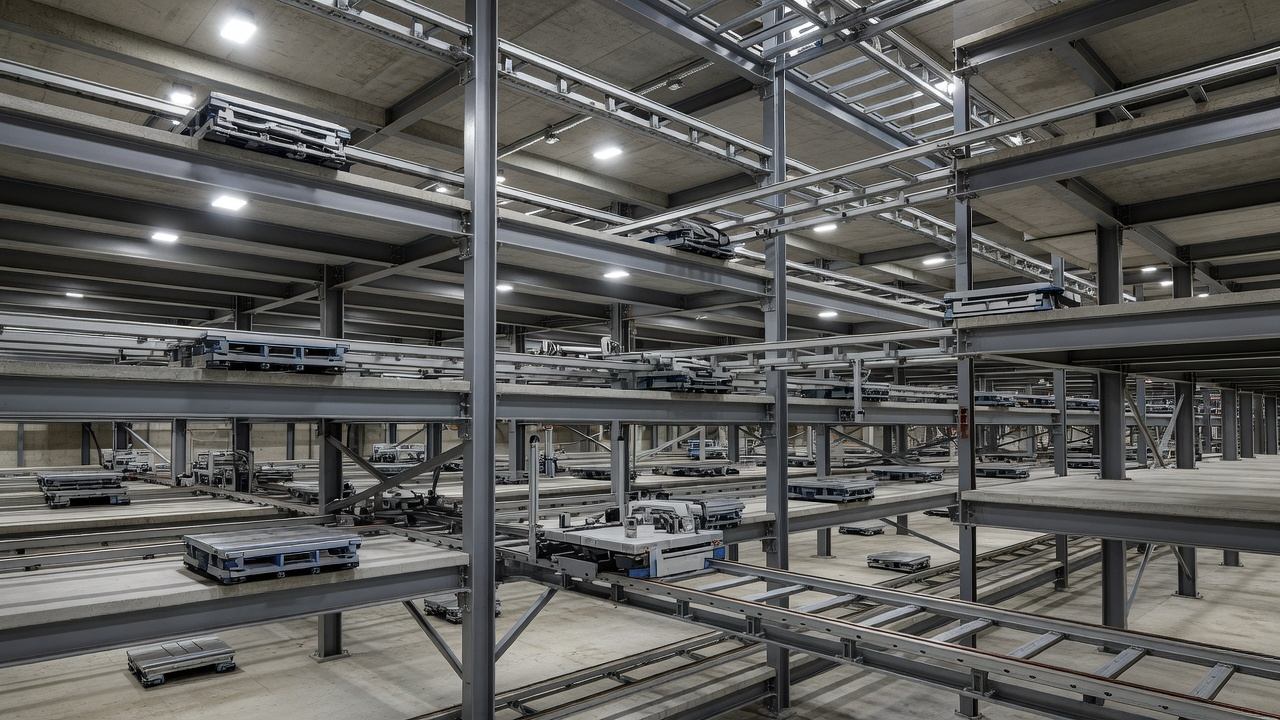
Automated parking has been the technology that was always about to arrive. Multi-level robotic systems, pallet-transfer towers, and car stacker systems have been commercially available since the 1990s, deployed extensively in Japan and Germany, and largely absent from mainstream North American and UK facility development for decades. The reasons have been straightforward: higher capital cost, longer cycle times per vehicle than conventional structures, and the persistent availability of cheaper land that made conventional garages the economic default.
Those conditions are changing. Land cost escalation in dense urban markets, the structural pressure to reduce parking footprints from municipal parking reform, and meaningful advances in system reliability are shifting the economic calculus. The 2026 market is not a revolution — it is a gradual re-evaluation of where automated systems genuinely outperform conventional structures and where they still don’t.
What the Market Actually Looks Like in 2026
The global automated parking systems market was valued at approximately $2.2 billion in 2024, with multiple forecasters projecting compound annual growth rates between 14 and 22 percent through 2030. The range of projections reflects genuine uncertainty about adoption rate, but the directional consensus is consistent: the market is growing faster than the broader construction sector.
By 2024, over 1,200 major urban installations of robotic parking systems had been registered globally. Fully automated systems — where no human drives into the storage area — accounted for 68 percent of commercial applications in 2025. The balance are semi-automated systems where drivers enter and exit on conventional ramps but parking within the structure is robotically assisted.
The geographic concentration remains notable. Japan, Germany, South Korea, and Gulf Cooperation Council markets lead in installation density. The GCC in particular has invested heavily in high-capacity automated systems: the government court complex in Kuwait commissioned a 2,314-space automated facility recognized by Guinness World Records as the largest automated parking installation in the world, spanning 11 levels with 12 entry and exit terminals.
North American deployments are growing but remain concentrated in specific market types: luxury residential towers, airport long-term facilities, hospital campuses, and transit-oriented development where land cost justification is clearest.
Why Urban Space Constraints Are the Actual Driver
The economics of automated parking are fundamentally a land cost story. Automated systems offer up to 45 percent higher parking density compared to conventional ramp garages — a function of eliminating drive aisles (no vehicle drives through the storage area), removing door-swing clearances (the car is delivered on a pallet), and stacking vehicles closer together vertically since headroom for a human driver is not required.
A conventional above-grade garage requires approximately 350 to 400 square feet of gross floor area per parking space, including drive aisles, ramps, and structural elements. A robotic pallet-transfer system can achieve 180 to 220 square feet per space in the same footprint. In markets where parking land cost exceeds $150 per square foot — central Manhattan, downtown San Francisco, central London — this density premium generates a land cost differential that can offset the 30 to 50 percent higher capital cost of the automated mechanical system within the project’s pro forma.
Below that land cost threshold, the conventional structure typically still wins on capital cost alone. The breakeven analysis is site-specific, but the general guidance from project finance practitioners is that automated systems become competitive in surface-lot replacement projects in urban cores where the value of the footprint reduction — either sold as additional residential or commercial area, or reflected in avoided land acquisition cost — is large enough to offset the equipment premium.
Westfalia Technologies’ 2025 demonstration that automated solutions can optimize land usage by up to 60 percent compared to conventional concrete garages uses a broader comparison that includes below-grade conventional construction, where automated systems show their largest advantage: a below-grade robotic installation eliminates the extensive ramp volume that conventional underground garages require.
System Architectures: What’s Actually Being Deployed
The term “automated parking” covers meaningfully different mechanical architectures. Understanding the distinctions matters for operators evaluating proposals, because each architecture has different throughput, reliability, and maintenance profiles.
Pallet transfer systems move vehicles on pallets through a horizontal and vertical transfer network using lift platforms and shuttle carriers. Vehicles are driven onto a pallet at the entry cabin; the system allocates a storage position and moves the pallet without human involvement. These systems offer high storage density and are the dominant architecture for large installations. Unitronics deployed a multi-level pallet transfer system in Tel Aviv in 2024 featuring app-based access and dynamic vehicle allocation based on traffic patterns. Klaus Multiparking and Wohr are the European market leaders in this category.
Tower systems (vertical circulation) store vehicles in a vertical stack within a cylindrical or rectangular tower structure, with a central lift mechanism that retrieves vehicles from any level. Tower systems work well in urban infill sites where horizontal footprint is the primary constraint. They are common in luxury residential applications where a single tower serves a building with 20 to 60 vehicles.
Robotic valet systems use autonomous ground-level robots that drive under the vehicle and lift it for transport — no pallets required. These systems are mechanically simpler than pallet-transfer networks and are better suited to flat, single-level facilities where building a multi-story structure isn’t viable. Westfalia’s WEPLUG system, announced in 2025, integrates DC fast charging into the robotic valet architecture, allowing the robot to connect a 50kW charger to the vehicle during storage without driver involvement.
Mechanical stackers — the puzzle-lift systems visible in many urban garages — are the least sophisticated form, moving vehicles vertically on platforms within a fixed grid. These are typically semi-automated: a driver enters the stack on a conventional aisle and the system handles vertical movement only. Throughput is lower than full pallet systems and retrieval times can be significant during peak periods.
The Throughput Problem
The persistent operational objection to automated parking systems is throughput: the time a driver waits from entry registration to vehicle storage completion, and from retrieval request to vehicle available at the exit cabin.
In conventional garages, throughput is essentially unlimited — the driver is the active element, and hundreds of vehicles can enter or exit simultaneously across multiple lanes. In automated systems, the mechanical handling equipment defines the maximum vehicles-per-hour throughput, and the system is a shared resource across all users.
Peak throughput for modern pallet-transfer systems typically runs 60 to 120 vehicles per hour per entry cabin, with retrieval adding 2 to 5 minutes from request to vehicle presentation. For applications with predictable peak demand patterns — transit hubs, airport long-term parking, residential facilities with predictable departure times — the system can be sized for the expected peak load. For event venues or sports facilities where hundreds of vehicles arrive and depart within a 30-minute window, the throughput constraint is a significant operational limitation that current automated systems cannot match.
System operators increasingly address this with pre-dispatch: an app-based retrieval request sent 10 to 15 minutes before the driver arrives at the exit cabin allows the system to begin retrieval proactively, reducing wait time at the cabin to under 60 seconds. This works when users reliably use the app; it breaks down when they don’t, reverting to on-demand retrieval queues.
Reliability and the Maintenance Profile
The other sustained criticism of automated parking systems is reliability: a mechanical failure in a conventional garage delays one vehicle. A control system failure in an automated facility can strand all vehicles in storage simultaneously, which is operationally unacceptable.
Modern systems address this through redundant control systems, multiple mechanical pathways within the storage field (so a single failed shuttle or lift doesn’t block all retrieval), and remote monitoring platforms that allow vendor technical staff to diagnose and frequently resolve control issues without on-site intervention.
Major vendors including Westfalia and Unitronics operate 24/7 remote monitoring centers with guaranteed response time commitments. System uptime of 99.5 percent or better is achievable in well-maintained installations, according to operator disclosures — but achieving that figure requires adherence to manufacturer maintenance schedules, which are more rigorous than the periodic maintenance a conventional garage structure requires.
Operators entering automated parking projects for the first time consistently underestimate the maintenance commitment: quarterly mechanical inspections, annual comprehensive servicing of all pallets and drive components, and software updates that require coordination with the manufacturer. The maintenance contract economics — typically 3 to 5 percent of capital cost per year — should be modeled in the project pro forma alongside debt service, not treated as an operational variable.
EV Integration: The 2026 Design Requirement
Any automated parking system specified in 2026 needs a clear answer to EV charging integration. The parking population in urban markets is shifting toward EVs at rates that vary by market but are consistently faster than most operators modeled three years ago. A robotic parking system installed in 2026 that cannot charge vehicles during storage will face retrofit pressure before its depreciation schedule runs out.
Two integration architectures are viable. The first is overhead robotic charging, exemplified by Westfalia’s WEPLUG system, where the robotic handling equipment connects a DC fast charger to the vehicle during storage. This approach doesn’t require electrifying every storage position — the robot delivers charging infrastructure to the vehicle — but requires compatible connector access on the vehicle and sophisticated coordination between the handling and charging control systems.
The second is pallet-level charging, where each pallet carries a Level 2 charging connector that mates with the vehicle when it is positioned in storage. This approach electrifies every position at Level 2 capacity, which is sufficient for overnight dwell times typical of residential applications, and adds cost to every pallet in the system.
Both architectures are commercially available. The choice depends on the application: high-dwell residential applications are suited to pallet-level Level 2; transit or airport applications with shorter but more predictable dwell times are better served by robotic DC fast charging capable of meaningful charge delivery in a 2 to 4 hour window.
Where the Market Is Headed
The automated parking market in 2026 is not about replacing conventional parking construction broadly. It is about filling the project types where conventional garages fail economically or physically: infill urban sites where footprint is insufficient for conventional ramp geometry, below-grade applications where ramp volume makes conventional construction prohibitively expensive, and premium residential or hospitality applications where the mechanical elegance of the system is part of the product offering.
The integration of EV charging, remote monitoring, and app-based access has removed some of the operational friction that previously made automated systems difficult to operate and market. The throughput constraints remain real, and the maintenance commitment remains significant. Operators who go in understanding both will build projects that perform as designed. Those who underweight throughput for their application or budget maintenance at conventional garage rates will have problems.
The market is growing because the economics work in specific conditions — not because automated parking has become generically superior to conventional structures. That distinction matters for every project feasibility analysis.
Further Reading
- Automated Parking System Market Report 2025 — GlobeNewswire — market sizing and key player profiles
- Westfalia Technologies — Automated Parking Solutions — WEPLUG robotic charging integration
- Grand View Research — Automated Parking Systems Market — market forecast methodology and segmentation
- Automated Robotic Parking Industry Resource — operator-facing reference for system types and vendors