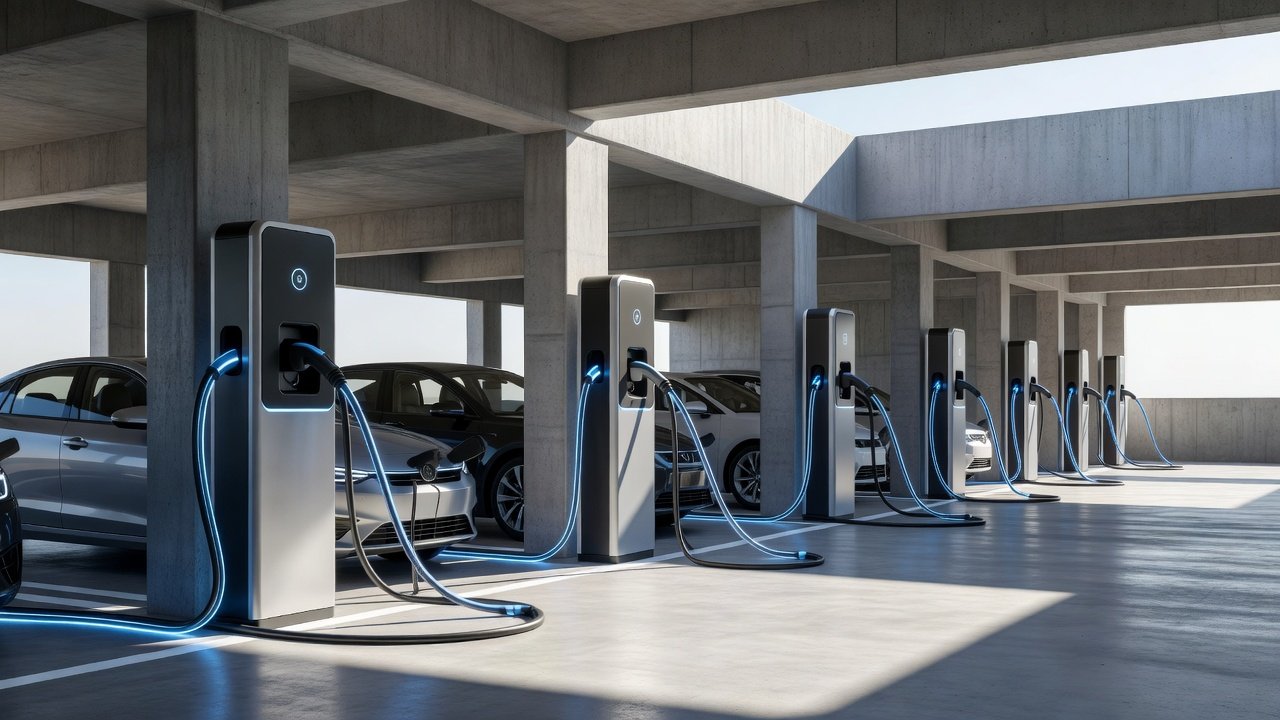
The EV charging infrastructure that parking operators installed in 2022 and 2023 was designed to do one thing: push electrons from the grid into vehicles. The hardware entering the market in 2026 does both directions — and the certification framework governing that capability has changed in ways that affect every procurement decision a facility manager makes today.
Bidirectional charging, specifically Vehicle-to-Grid AC (V2G-AC), turns parked EVs into controllable grid assets. A parking facility with 50 bidirectional-capable chargers and a fleet of willing EV drivers isn’t just an amenity — it’s a distributed energy resource that utilities will pay to dispatch. Getting there requires understanding UL 1741, what SA and the forthcoming SC supplement actually specify, and why certification pathway matters when writing equipment specs.
What UL 1741 Actually Covers
UL 1741 is the primary US safety standard for inverters, converters, and interconnection system equipment used with distributed energy resources. It was originally written for solar inverters and stationary battery systems, but has been extended through supplemental annexes to cover the specific interconnection requirements for grid-tied EV charging equipment.
UL 1741 SA (Supplement A) addresses inverters that provide grid-support functions — frequency response, voltage regulation, ramp rates — as required by California’s Rule 21 and similar state interconnection tariffs. Fermata Energy’s FE-20 bidirectional charger was the first product to receive joint UL 9741 and UL 1741 SA certification, a milestone that demonstrated the viability of the standards pathway for bidirectional EVSE rather than just stationary storage.
UL 1741 SC (Supplement C) is the standard specifically developed for AC Bidirectional Electric Vehicle Supply Equipment (BEVSE) and Interconnection Systems Equipment (ISE) for EVs with SAE J3072 bidirectional onboard inverters. As of May 2026, UL 1741 SC received a published update incorporating the SC requirements, formalizing the pathway that had previously operated through interim Certification Requirement Decisions (CRDs). Products certifying through the CRD route established compliance before SC was finalized; ongoing certifications now move to the full SC framework.
The distinction between SA and SC matters for procurement: SA-certified equipment provides grid support from a standalone inverter, while SC-certified equipment certifies the AC bidirectional flow through the vehicle’s own onboard inverter — a different topology with different safety requirements.
Why Certification Pathway Determines What You Can Deploy
A charger marketed as “V2G-capable” without specifying its certification pathway may not be interconnectable with your utility. Grid-support functions — the capabilities that make bidirectional charging economically valuable — require utility interconnection approval, and most US utilities ground their approval processes in IEEE 1547-2018 compliance plus the relevant UL 1741 supplement.
California’s Rule 21 explicitly requires UL 1741 SA (or SA-equivalent) certification for inverters participating in grid-support functions on the CAISO grid. Pacific Gas & Electric, Southern California Edison, and San Diego Gas & Electric all enforce this requirement at the interconnection application stage. A bidirectional charger that lacks SA or SC certification can still charge vehicles — but it cannot participate in the demand response, frequency regulation, or export programs that generate revenue for the operator.
The California Energy Commission’s V2GEL (Vehicle-to-Grid and Energy-to-Load) program, which provides funding for bidirectional charging deployments, similarly requires that funded equipment use certified bidirectional EVSE meeting IEEE 1547 and applicable UL standards. Operators pursuing V2GEL grants need to verify that their specified equipment is on the CEC’s eligible equipment list, which tracks certification status.
Outside California, states with active V2G utility programs — including New York, Massachusetts, and Hawaii — are building their interconnection frameworks around the same SA/SC certification requirements. Operators in regulated utility markets elsewhere should expect similar requirements to appear within 24 to 36 months as state public utility commissions update interconnection tariffs.
The Grid Services Revenue Case for Parking Operators
The argument for bidirectional infrastructure is not purely about differentiation. Pilot programs provide concrete numbers: commercial fleet operators participating in frequency regulation and demand response programs through bidirectional charging have demonstrated $1,000 to $5,000 per vehicle annually in grid services revenue, depending on the utility market and program structure.
Fleet-operated school buses have shown higher returns in some markets — a program run by National Grid in Beverly, Massachusetts, generated over $60,000 in grid services revenue from three buses over three summers, primarily through demand response dispatch during peak grid stress events.
These numbers don’t translate directly to a mixed-use public parking facility, where dwell times are shorter and vehicle availability is less predictable than a depot fleet. But they establish the revenue order of magnitude that makes bidirectional infrastructure worth the hardware premium — currently estimated at 20 to 40 percent above equivalent unidirectional EVSE.
Parking operators have a structural advantage over residential V2G adopters: density. A 200-space garage with 40 percent EV penetration and even 30 percent of those vehicles enrolled in a V2G program represents 24 vehicles at typical times — a meaningful aggregated resource that a demand response aggregator can dispatch as a block. Residential programs depend on hundreds of individually enrolled drivers who may or may not be home. A parking facility’s grid contribution is concentrated, predictable during peak dwell hours, and manageable through the facility’s energy management system.
What the SAE J3072 Standard Requires of the Vehicle
UL 1741 SC’s scope is specifically tied to vehicles with SAE J3072 bidirectional onboard inverters. J3072 defines the communication protocol and interface requirements for AC bidirectional charging through the vehicle’s existing onboard charger — meaning the vehicle’s own power electronics export AC power back through the J1772 connector, rather than requiring a separate high-voltage DC export port.
This architecture matters because it dramatically expands the range of vehicles that can participate in AC V2G without requiring specialized off-board inverter hardware. Vehicles with J3072-compatible onboard chargers can use a standard Level 2 charging cable for both import and export. The constraint is the vehicle side: as of mid-2026, production J3072-compatible vehicles remain limited, though Nissan has committed to embedding bidirectional inverters as standard hardware in the redesigned Leaf beginning in the 2026 model year, and Ford’s commercial vehicle division has announced similar roadmaps for fleet-oriented models.
For parking operators writing long-term infrastructure specifications, the J3072 architecture implies specifying EVSE that supports both import-only and bidirectional operation — since the same charger serves vehicles with and without export capability. A parking operator who specifies bidirectional-only EVSE to save cost will face compatibility issues with the majority of EVs in their lot for the next several years.
Practical Implications for Parking Facility Procurement
The certification and standards landscape creates specific requirements for operators specifying EVSE in 2026:
Demand UL 1741 SA or SC documentation. Any vendor claiming V2G-AC capability should be able to provide their UL certification number and confirm which supplement applies. Products certified only under the base UL 1741 standard (without SA or SC) cannot legally operate grid-support functions in states with Rule 21-equivalent requirements.
Verify utility interconnection applicability. Confirm with your serving utility that the specific certified product is on their approved equipment list for distributed generation interconnection. California’s Rule 21 approved equipment database and New York’s DER Connect portal both maintain searchable lists. Approval for one utility territory does not automatically transfer to another.
Plan electrical infrastructure for bidirectional capacity. Bidirectional operation at scale places different demands on facility electrical systems than import-only charging. Export events — when vehicles discharge to the grid — can create momentary current reversals that older switchgear and metering equipment was not designed to handle. Facilities planning more than 20 bidirectional-capable chargers should have their electrical engineer review the switchgear and meter configuration with the utility before procurement.
Confirm demand response aggregator relationships. Bidirectional hardware alone does not generate revenue. Operators need a demand response aggregator or a direct utility program to sell grid services. The Mobility House, Nuvve, and Fermata Energy all operate aggregation platforms in multiple US markets. Establishing this relationship before hardware procurement ensures the revenue model is validated before the capital commitment is made.
The V2G-AC market has moved from a research curiosity to a certifiable, interconnectable product category. Parking operators who understand the certification framework are positioned to specify the right hardware — and to access the grid services revenue that transforms an EV charging program from a cost center into a partial income stream.
Further Reading
- UL Solutions — V2G and EVPE Market Access — certification pathways for bidirectional EVSE
- California Energy Commission V2GEL Program — funding and eligible equipment for bidirectional deployments
- US DOE — Bidirectional Charging and Electric Vehicles for Mobile Storage — federal program context
- SAE International — J3072 Standard — onboard charger communication requirements for AC bidirectional operation