The hardest unsolved problem in EV adoption is not range and it is not the public charging network. It is that roughly 31% of U.S. residences are multi-family — apartments, townhouses, condominiums — and a driver who parks in a shared garage frequently has no lawful way to install the thing that makes an EV practical.
The policy response to that has a name, and it has spread faster than most people tracking parking policy have noticed. Right-to-charge laws now exist in over 30 U.S. states, and the pattern they establish is being replicated in jurisdictions well beyond the states that pioneered it.
For anyone who designs, manages, or invests in multi-unit parking, this is not an EV story. It is a parking policy story with electrical infrastructure attached.
What These Laws Actually Do
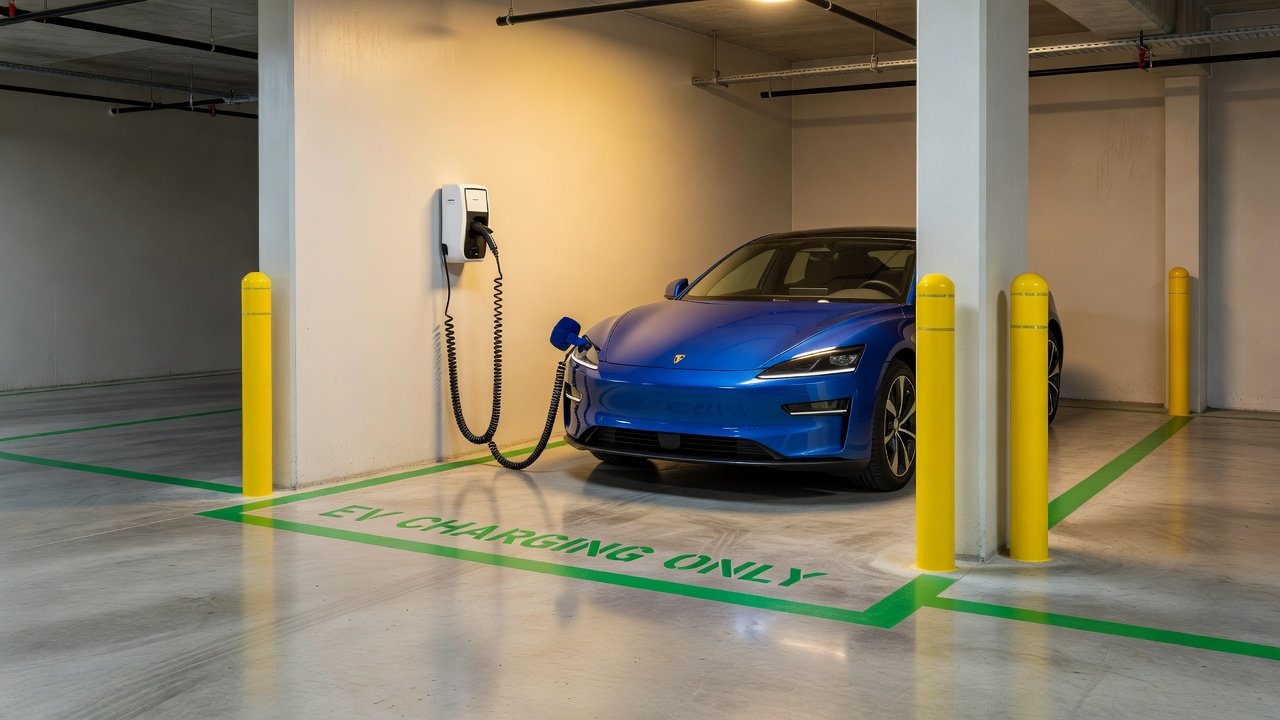
The core mechanism is narrow and consistent. Right-to-charge statutes prohibit homeowners associations and condominium associations from unreasonably restricting the installation of EV charging equipment in a space that an owner owns or has assigned to them.
The typical structure includes a response obligation — associations commonly must respond to a request within around 60 days — and a cost allocation that puts the expense on the requesting resident. In most implementations the resident covers the equipment, the installation, the permits, and the ongoing electricity. The association is not required to buy anything.
That cost allocation is why these laws have been politically viable. They are not a mandate to electrify a building; they are a removal of a veto. An association can still impose reasonable conditions — insurance requirements, licensed installation, aesthetic and safety standards, submetering — but it cannot simply say no.
The reach has become broad enough that even in states without specific legislation, blanket bans on EV charger installation are increasingly difficult to enforce.
The Gap the Laws Do Not Close
There is a significant limitation that shapes the entire practical picture: these laws generally apply to owner-occupied units with assigned parking. Condominiums and HOA communities where the resident owns or is deeded a specific space.
Renters have far fewer protections in most states, and renters are a large share of exactly the multi-unit population that most needs the access. A tenant in an apartment building with unassigned surface parking is outside the protection in nearly every implementation, because there is no space to attach the right to.
This produces a policy landscape where the driver most likely to have a legal path to a home charger is the one most likely to have been able to afford an alternative — and it is the main reason right-to-charge, on its own, has not solved the multi-unit charging problem.
Why This Is Becoming a Global Pattern
The reason this is worth watching as an international trend rather than a U.S. state-law curiosity is that the underlying problem is identical everywhere EVs are adopted, and the structural solution is converging.
Every jurisdiction with dense housing hits the same sequence. EV adoption grows among owners with driveways. It stalls at the multi-unit boundary. Associations block installations, citing electrical capacity, cost allocation, aesthetics, or liability. The blocking becomes a visible barrier to a stated decarbonization objective. And the legislative response — remove the veto, assign the cost to the requester, impose a response deadline — is the cheapest available intervention because it requires no public spending.
That is why the shape recurs. It is not policy diffusion so much as independent arrival at the same low-cost answer.
What It Means for Parking Design and Management
The operational consequences land on parking, not on utilities, and they are underappreciated.
Electrical capacity becomes a parking planning constraint. A garage that receives twelve individual right-to-charge installations over three years, each engineered independently by a different resident’s contractor, ends up with a capacity problem and a wiring situation that nobody designed. The associations that handle this well get ahead of it with a building-wide EV infrastructure plan and a defined connection point, so individual installations tie into a coherent system rather than accumulating.
Load management is the technical answer and it is now cheap. The capacity objection that associations traditionally raised — the building’s service cannot support everyone charging — is largely solved by managed charging that shares available capacity across connected vehicles. An association still asserting a hard capacity limit without having evaluated load management is on weak ground.
Submetering and cost recovery need a policy before the first request. The statutes generally put electricity cost on the resident, but a building with common-metered garage circuits has no way to implement that without submetering. Deciding this after the first installation is far harder than deciding it before.
Space assignment becomes contested. In buildings where spaces are assigned rather than deeded, the question of whether a resident can be moved to a space nearer the electrical room — or whether an EV owner can be required to swap — becomes a live governance issue. Buildings that write this into policy in advance avoid a specific and predictable fight.
Reasonable conditions have to be written down. The laws permit reasonable restrictions. An association that has documented insurance, installation-standard, inspection, and aesthetic requirements in advance is applying a policy. One that invents conditions in response to a request is much more exposed to the “unreasonably restricting” standard.
The Direction of Travel
The current generation of right-to-charge law is a first step and it looks like one in retrospect. It solves the veto problem for owners and leaves the renter problem, the unassigned-parking problem, and the building-capacity problem to be handled by whoever happens to be in the room.
The jurisdictions moving next are approaching it from the other end — EV-ready requirements in new multi-unit construction, where conduit and panel capacity are provided at build for a fraction of the retrofit cost. That is the more durable intervention, and it is where the policy conversation is heading in the places that adopted right-to-charge earliest.
For parking professionals, the practical position is straightforward. If you manage multi-unit residential parking in a right-to-charge jurisdiction, the request is coming, and the difference between a managed program and a series of individual installations is decided entirely by whether a plan existed before the first one arrived. Verify the specific statute in your jurisdiction — the response deadlines, cost allocation, and permitted conditions vary meaningfully between them — and build the policy against that text rather than against a general summary.