The National Electric Vehicle Infrastructure (NEVI) Formula Program had one of the stranger years in recent federal infrastructure history. Funded under the Bipartisan Infrastructure Law with $5 billion over five years, NEVI was supposed to be the engine of a national EV charging buildout — and then it stalled. As of late 2025, fewer than 400 charging ports had actually been built from the program, despite billions in apportioned funds.
The reasons were a mix of procurement complexity, state plan approval delays, and a 2025 federal pause under the new administration. But the program is moving again. In August 2025, Transportation Secretary Sean Duffy issued revised NEVI guidance designed to cut red tape, give states more deployment flexibility, and accelerate the buildout. Multiple states have since reopened funding rounds, and the Alternative Fuels Data Center confirms that $885 million is apportioned for FY2026 — with states that have submitted updated deployment plans now receiving those funds.
For parking facility operators and planners, the NEVI reboot matters in ways that go beyond corridor charging. The off-corridor flexibility now available to states whose Alternative Fuel Corridors are certified as “Fully Built-Out” opens the door for parking facilities to qualify as NEVI-funded EVSE sites — a significant funding opportunity for operators considering DCFC installation.
What Happened: The 2025 Pause and the Program Restart
NEVI was structured as a formula allocation: each state receives a proportional share annually based on total lane miles of federal-aid highways and number of registered EVs, with a minimum floor per state. The program ran from FY2022 through FY2026, with annual plans required by August 1 of each year.
The 2025 pause came when the Trump administration froze discretionary grant disbursements across multiple agencies while reviewing Biden-era programs. NEVI Formula funds were technically formula program funds rather than discretionary grants — a distinction that courts eventually upheld. In Washington v. U.S. Department of Transportation, a federal court ruled that the administration had exceeded its authority in pausing NEVI disbursements, restoring state access to funds that had been withheld.
Simultaneously, the DOT issued revised program guidance that genuinely changed how NEVI works:
- Streamlined procurement requirements. States can now move faster through site selection and contractor agreements without the multi-step federal review process that had slowed early rounds.
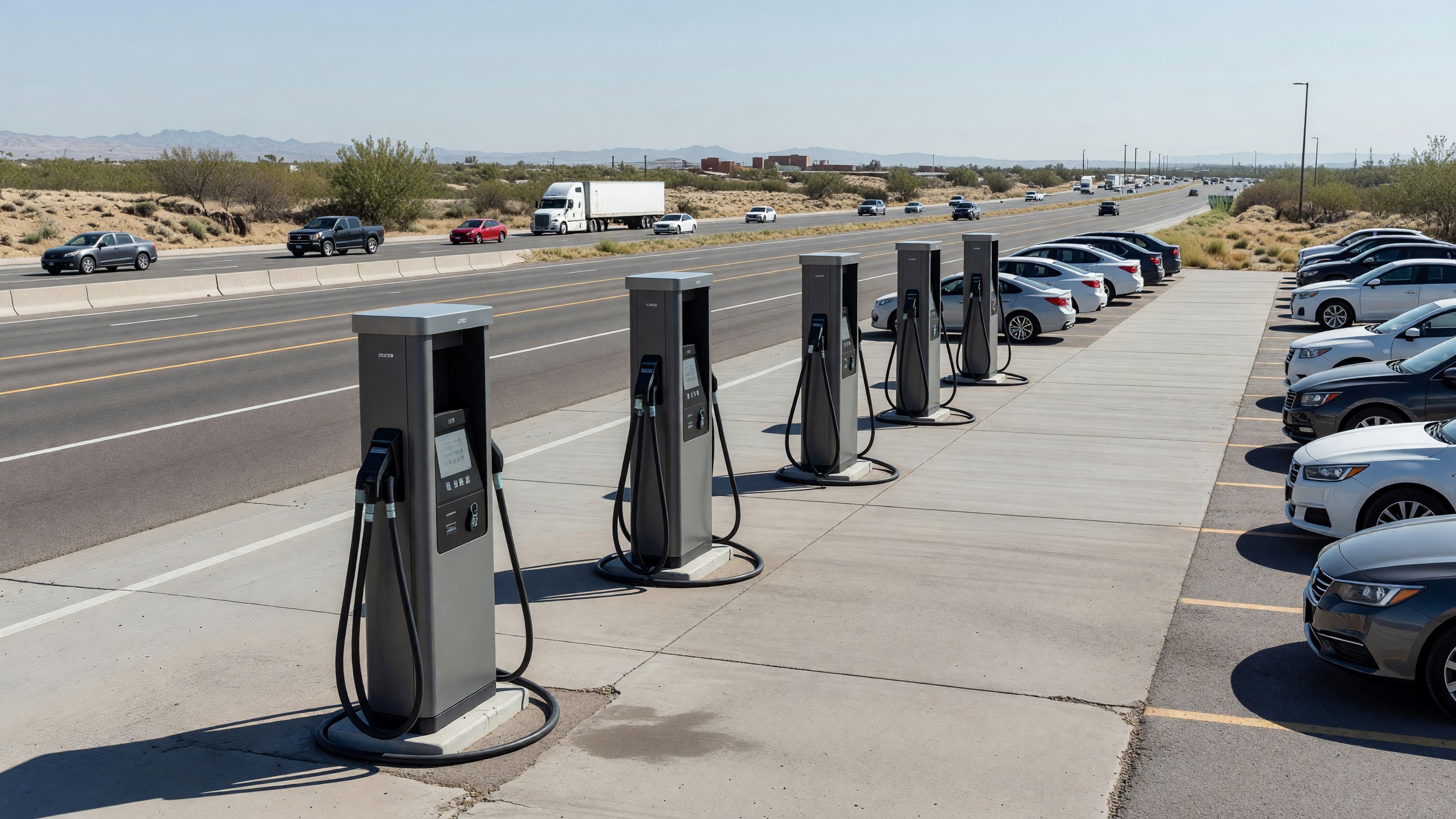
- Expanded eligibility for non-highway-adjacent sites. States that achieve “Fully Built-Out” status on their designated Alternative Fuel Corridors (meaning compliant chargers every 50 miles, within 1 mile of the highway) can now deploy remaining NEVI funds at off-corridor locations, including parking facilities, destinations, and community charging sites.
- More connector flexibility. Earlier guidance strictly required Combined Charging System (CCS) connectors. Revised guidance accommodates both NACS (Tesla-standard) and CCS dual-connector configurations, reflecting the industry’s shift.
The net result is a program that is both better funded — with $885 million in FY2026 apportionment — and more operationally accessible than it was under the original 2022 guidance.
What $885 Million Apportioned Means in Practice
The $885 million FY2026 figure is an apportionment, not a disbursement. Apportionment means the funds have been allocated to states by formula and are available for state programs to draw down as projects are approved and constructed. Actual disbursement lags construction.
The Eno Center for Transportation has flagged a complicating factor: pending FY2026 appropriations language that would transfer approximately $879 million of NEVI funds into other FHWA programs. If this provision survives the appropriations process, it would effectively redirect the FY2026 tranche away from EVSE deployment. This transfer was enacted in the FY2026 appropriations process (the Consolidated Appropriations Act, 2026), and operators and planners should treat the redirected FY2026 tranche as a material constraint when making NEVI-contingent investment decisions.
Assuming the funds remain available, the state-level picture is what matters for operators. States open funding rounds for private entities — including parking operators, property owners, fuel retailers, and municipalities — to apply as site hosts and project proponents. The federal share covers up to 80% of eligible project costs, with the applicant covering the remaining 20%.
States currently in active 2026 rounds or expecting to open rounds shortly include Pennsylvania (Corridor Connections round completed in early 2026), Vermont (second solicitation expected mid-2026 after achieving Fully Built-Out corridor status), Oregon (grant agreements in place, first stations expected 2027), and a number of others that paused during 2025 and are now processing their resumed applications.
Off-Corridor Flexibility: The Opening for Parking Facilities
The most significant development for parking operators in the revised NEVI guidance is off-corridor deployment eligibility.
Under the original framework, NEVI funds had to be deployed within one mile of designated Alternative Fuel Corridors (AFCs) until those corridors were fully built out. This constrained site selection almost entirely to highway-adjacent locations — travel plazas, fuel stations, and highway commercial exits. Urban and suburban parking facilities, which are where most EVs actually park and charge during the day, were not eligible.
The “Fully Built-Out” designation changes this. Once a state’s AFC network is certified — meaning every 50-mile segment has at least one compliant DCFC hub within one mile of the highway — the state can direct remaining NEVI funds to off-corridor locations. Vermont achieved this designation in October 2025. Other states are approaching it as their corridor rounds complete.
For parking operators, the implication is that NEVI funding is becoming available for:
- Urban structured parking. Downtown garages and mixed-use parking structures near employment and retail destinations.
- Airport parking. Economy lots, hourly garages, and consolidated rental car facilities.
- Destination and lodging parking. Hotels, resort facilities, and entertainment-adjacent parking that represent multi-hour dwell times — the minimum 30-minute charge window that justifies DCFC investment.
- Transit park-and-ride facilities. State DOTs and transit agencies are natural NEVI program applicants for commuter-adjacent DCFC deployment.
The practical pathway for a parking operator to pursue NEVI funding is through the state’s program solicitation, not through a direct federal application. Each state DOT administers its NEVI program and sets its own eligibility criteria, minimum charging specifications, and site selection priorities within the federal framework.
Technical Requirements Operators Must Meet
NEVI-funded EVSE carries federal minimum standards that are higher than typical Level 2 or basic DCFC installation. Operators considering pursuing NEVI funding — or simply future-proofing their EVSE infrastructure to be compatible with NEVI standards — should understand what those requirements entail.
Charging power. NEVI minimum standards require at least four charging ports per station, each rated at a minimum of 150 kW DC fast charging capability. This is a significant electrical infrastructure commitment — not a Level 2 installation and not a single-port DCFC.
Connector standards. Current guidance requires both CCS (J1772 combo) and NACS connectors, or a configuration that can accommodate both standards. The dual-connector requirement ensures the widest vehicle compatibility as the industry transitions.
Network connectivity and data reporting. NEVI stations must be networked, capable of real-time status reporting to a federal data platform (the EV data portal managed by FHWA). Uptime reporting, session data, and station availability must be transmitted continuously.
Uptime requirement. A 97% network uptime standard applies — meaning each port must be operational and available to the public 97% of the time on an annual basis. This is substantially higher than the typical reliability of earlier-generation public charging infrastructure, and it has real implications for maintenance contracts and network provider selection.
Payment and accessibility. NEVI stations must accept payment without an account or membership requirement — meaning credit card or contactless payment at the station without a mobile app sign-up step. ADA accessibility requirements apply.
These standards are documented in full under 23 CFR Part 680, the federal rule codifying NEVI minimum standards.
What Parking Operators Should Do Now
The NEVI program’s off-corridor expansion is a planning signal, not an immediate action item for most operators. The practical steps depend on your facility type, state, and investment timeline.
Check your state’s NEVI program status. State DOTs publish their NEVI program pages with active solicitation windows and upcoming rounds. If your state has achieved or is approaching Fully Built-Out corridor status, off-corridor solicitations are imminent.
Assess your electrical infrastructure. A 150 kW DCFC installation requires meaningful service capacity — typically a dedicated transformer in a structured parking environment, with conduit runs and switchgear that often aren’t in place in facilities built without EV charging in mind. The electrical site assessment is the long-lead item; it should happen before a solicitation opens, not after.
Understand the 80/20 split. The federal cost share covers up to 80% of eligible project costs. “Eligible costs” under NEVI include charger hardware, installation, network connectivity, and certain site preparation costs. It does not include structural modifications to the parking facility itself. A realistic project budget accounts for both NEVI-eligible and non-eligible cost categories.
Consider the 97% uptime obligation. Committing to NEVI-funded infrastructure means committing to that uptime standard, typically enforced through the network provider’s service level agreement. Factor maintenance and repair cost structures into the project economics before applying.
For operators earlier in the EV planning process, the broader EV charging infrastructure planning guide covers the site assessment and charging level decision framework that should precede any NEVI-specific conversation.
What the Program Reboot Doesn’t Resolve
The NEVI reboot is real, but the program’s structural challenges have not fully disappeared.
Funding appropriation risk. The pending transfer of $879 million from NEVI into other FHWA programs — if it survives the FY2026 appropriations process — would dramatically reduce the funding available for this cycle. Operators building investment cases around NEVI availability should treat this as a material risk.
State capacity variation. The 50 states are in very different positions on their NEVI programs. Some have run three or four competitive rounds and have a functioning procurement pipeline. Others are still working through their first solicitations. The operator experience of the program varies significantly by state.
Deployment lag. The gap between funds apportioned and chargers built has been the defining feature of NEVI since 2022. The revised guidance reduces procedural friction but does not eliminate the construction and permitting timeline. Operators who pursue NEVI funding should plan for an 18–30 month timeline from application to operational chargers.
The program reboot is a meaningful development for parking-adjacent EV infrastructure planning. The funding, the off-corridor flexibility, and the simplified guidance all represent genuine improvements. What the reboot does not provide is certainty about the ultimate scale of deployment before the program’s FY2026 authorization expires.
Frequently Asked Questions
What is the NEVI Formula Program?
NEVI is a federal program created under the 2021 Bipartisan Infrastructure Law that provides $5 billion over five years to states to deploy EV charging infrastructure along designated highway corridors and, increasingly, at off-corridor sites. Each state receives a formula allocation annually based on lane miles and registered EVs.
How much NEVI funding is available in 2026?
$885 million is apportioned for FY2026, distributed to states that have submitted updated deployment plans. However, the FY2026 appropriations act (Consolidated Appropriations Act, 2026) redirected a significant portion of these funds to other FHWA programs, materially reducing the amount actually available for EVSE deployment this cycle.
Can parking facilities receive NEVI funding?
Potentially, yes — for parking facilities in states that have achieved “Fully Built-Out” status on their Alternative Fuel Corridors, which allows NEVI funds to be deployed at off-corridor locations including parking facilities, destinations, and community charging sites. Eligibility is determined through each state’s NEVI program solicitation, not through a direct federal application.
What are the minimum technical requirements for NEVI-funded chargers?
NEVI minimum standards require at least four charging ports per station at a minimum of 150 kW DC fast charging, dual NACS/CCS connector capability, network connectivity with real-time data reporting, 97% annual uptime, and credit/contactless payment without account creation.
How does an operator apply for NEVI funding?
Through the state DOT’s NEVI program solicitation. There is no direct federal application — states run their own competitive rounds, set site eligibility criteria, and select projects within the federal framework. Contact your state DOT’s NEVI program office for current solicitation windows.
What happened to NEVI in 2025?
The Trump administration paused NEVI disbursements in early 2025 as part of a broader freeze on discretionary program funds. Courts ruled that NEVI formula funds could not be withheld, restoring state access to the funds. The DOT subsequently issued revised guidance that streamlined requirements and expanded off-corridor eligibility.