The National Electric Vehicle Infrastructure program has had a rougher road than most federal initiatives. After a February 2025 freeze that suspended all previously approved state plans, a federal court order overturned the halt, and by August 2025 the Federal Highway Administration released new interim guidance allowing states to resubmit deployment plans and unlock frozen funds. As of 2026, $885 million in FY2026 apportionments is moving to states — and the program’s expanded eligibility rules are opening doors that parking operators would be wrong to ignore.
What Changed in the 2026 Reboot
The August 2025 interim final guidance didn’t just restart the program — it reshaped it. Three changes stand out for anyone thinking about parking-adjacent charging infrastructure.
Corridors First, Then Communities
The original NEVI framework was built around Alternative Fuel Corridors (AFCs): designated highway routes where chargers had to be spaced no more than 50 miles apart. That architecture made sense for cross-country travel anxiety but did little for urban parking operators sitting a mile off the interstate.
The 2026 guidance changes the sequencing. Once a state’s AFC network achieves “full built-out” certification from FHWA, that state can redirect NEVI formula funds to EV charging infrastructure on any public road or publicly accessible location — including parking facilities. Multiple states are already executing this pivot. New York’s NYSERDA announced a $45 million Alternative Fuel Corridor and Community NEVI DCFC Program in April 2026 specifically targeting locations that are currently underserved by DC fast charging. Pennsylvania launched its first Community Charging funding round in February 2026, with $100 million committed across four regional rounds throughout the year.
Dual Connector Requirements Are Now Standard
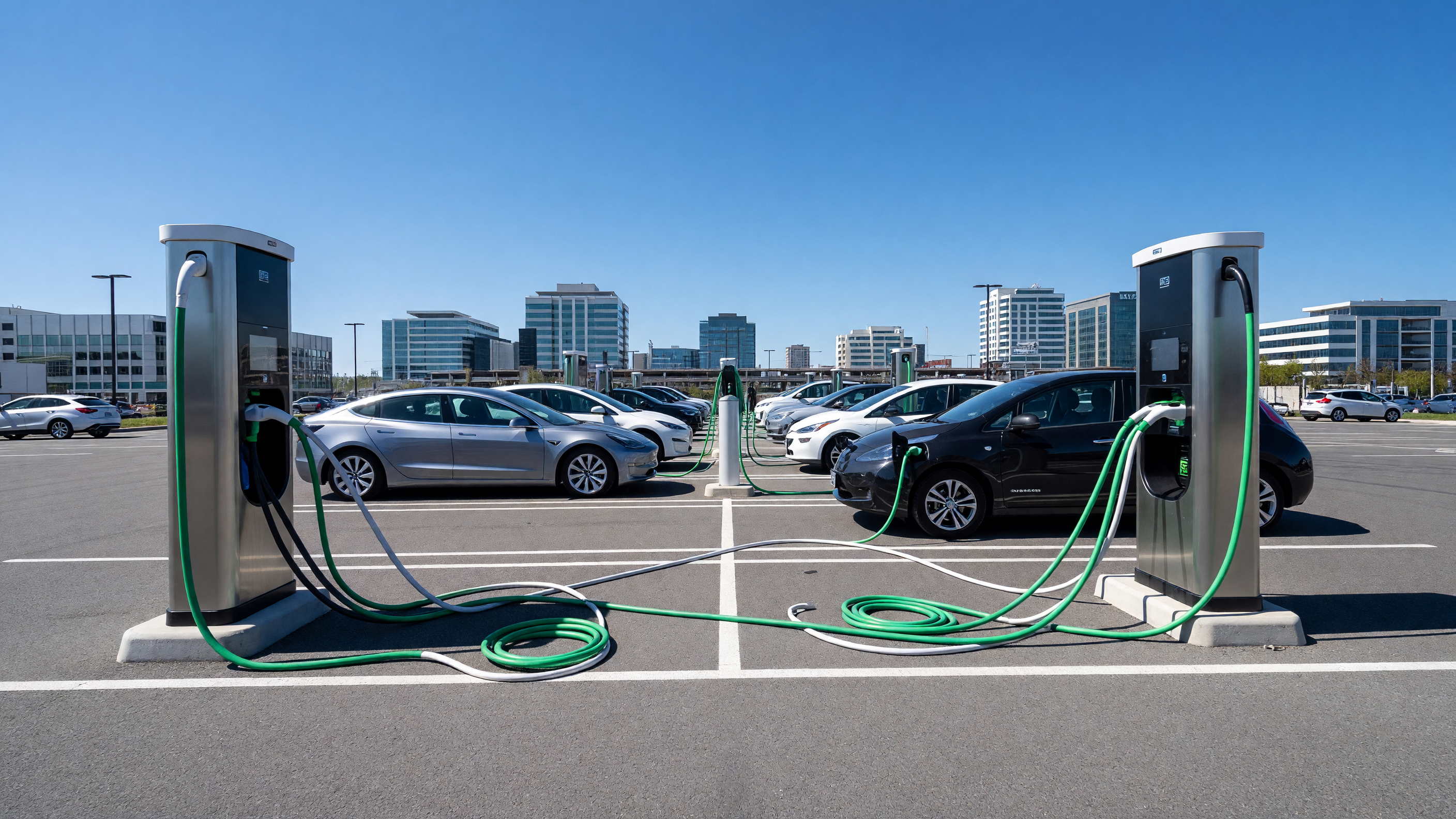
The updated guidance mandates that new NEVI-funded sites include both CCS and NACS connectors. For parking operators planning future installations, this matters because it sets the minimum viable spec for any site that wants to remain eligible for federal reimbursement. A single-connector installation built today may be ineligible for NEVI funding tomorrow.
Faster Approvals and Greater State Flexibility
States now have more discretion on station spacing along corridors and face a streamlined approval process for corridor buildout certification. That accelerated certification pathway is meaningful: the faster a state achieves full AFC buildout, the sooner it can redirect funds toward community and urban locations — where parking infrastructure sits.
The Parking Operator’s Window
As of mid-2025, at least 384 EV charging ports had been built through NEVI funding nationally, a number that understates the program’s momentum given that over 500 stations were operational, under construction, or in final procurement by July 2025. That baseline is growing quickly.
For parking operators, the practical opportunity breaks into two distinct tracks.
Highway-Adjacent Parking
Parking facilities near interstate corridors — rest stop–adjacent surface lots, travel plaza garages, airport remote parking — have always been technically eligible for NEVI corridor funding. The challenge has been competitive: corridor sites have historically prioritized fuel retailers and standalone DCFC plazas. But as corridors fill in and states shift attention to underserved community locations, highway-adjacent parking with captive dwell time becomes a stronger candidate. Vehicles parked for 30–90 minutes while owners rest or catch a flight are ideal DCFC customers.
Urban and Suburban Garage Operators
This is where the 2026 guidance shift matters most. States with completed corridor certification can now fund DCFC installations in urban parking structures, city-owned surface lots, and mixed-use parking decks. Kansas’s Department of Transportation issued an RFP in June 2026 for exactly this type of deployment. Colorado’s Energy Office has been running DCFC plaza grants alongside NEVI that explicitly include parking-adjacent sites.
Parking operators in states approaching AFC completion should be tracking their state DOT’s certification timeline. The window between corridor completion and community round opening is where early movers have positioned successfully.
Revenue Reality: What the Numbers Actually Support
Federal funding de-risks the capital side of an EV charging installation, but operators still need to model ongoing revenue. The range in charging revenue is wide: Level 2 chargers in moderately trafficked facilities generate in the neighborhood of $6,000–$18,000 per unit annually, while DC fast chargers in high-demand locations can reach $36,000–$144,000 per unit per year. Those upper figures assume utilization rates that most facilities won’t see at launch.
The more defensible near-term revenue argument for parking operators isn’t peak charging throughput — it’s dwell-time capture and facility differentiation. EV drivers actively seek parking that offers charging; a garage that shows as charging-available on PlugShare, Apple Maps, or Google Maps draws a customer segment that would otherwise park elsewhere. In dense urban markets where parking selection is already competitive, that visibility has measurable impact on occupancy.
Charging-as-a-Service as a Risk Mitigation Tool
For operators who want EV charging without owning the infrastructure risk, Charging-as-a-Service arrangements with established EVSE providers shift hardware ownership, maintenance liability, and network management to a third party. The operator provides the real estate and electrical access; the provider handles everything else and typically shares a revenue percentage. Under NEVI’s updated guidance, some states allow CaaS-style owner-operated sites to qualify for funding — worth verifying in your state’s specific solicitation terms.
What Parking Planners and City Officials Should Be Doing Now
State NEVI funding rounds are competitive and time-bound. Kansas’s June 2026 RFP, Pennsylvania’s regional rounds, and New York’s $45 million community program all have application deadlines. Parking operators and city fleet managers who wait for the next federal program cycle may find 2026 funds already committed.
Three concrete actions for anyone in the parking-adjacent EV space right now:
Track your state DOT’s AFC certification status. FHWA publishes corridor buildout progress. Knowing whether your state has achieved full buildout tells you whether community-location funding is already available or still in the pipeline.
Assess electrical capacity before applying. NEVI-funded DCFC installations require significant electrical service upgrades in most parking structures. The lead time on utility interconnection — often six to eighteen months — is the variable that catches applicants off guard. An electrical feasibility assessment completed before the RFP opens positions an operator to respond with a realistic timeline.
Engage your state’s NEVI coordinator directly. Every state DOT has a designated NEVI contact. Early conversations about site eligibility, application requirements, and funding round timing are standard — and provide the informal guidance that shapes a competitive application.
The NEVI program has survived a politically turbulent stretch and emerged with more flexible rules than it started with. For parking operators who have been watching from the sidelines, the 2026 reboot is the clearest signal yet that the federal EV infrastructure build-out is no longer just a highway story.