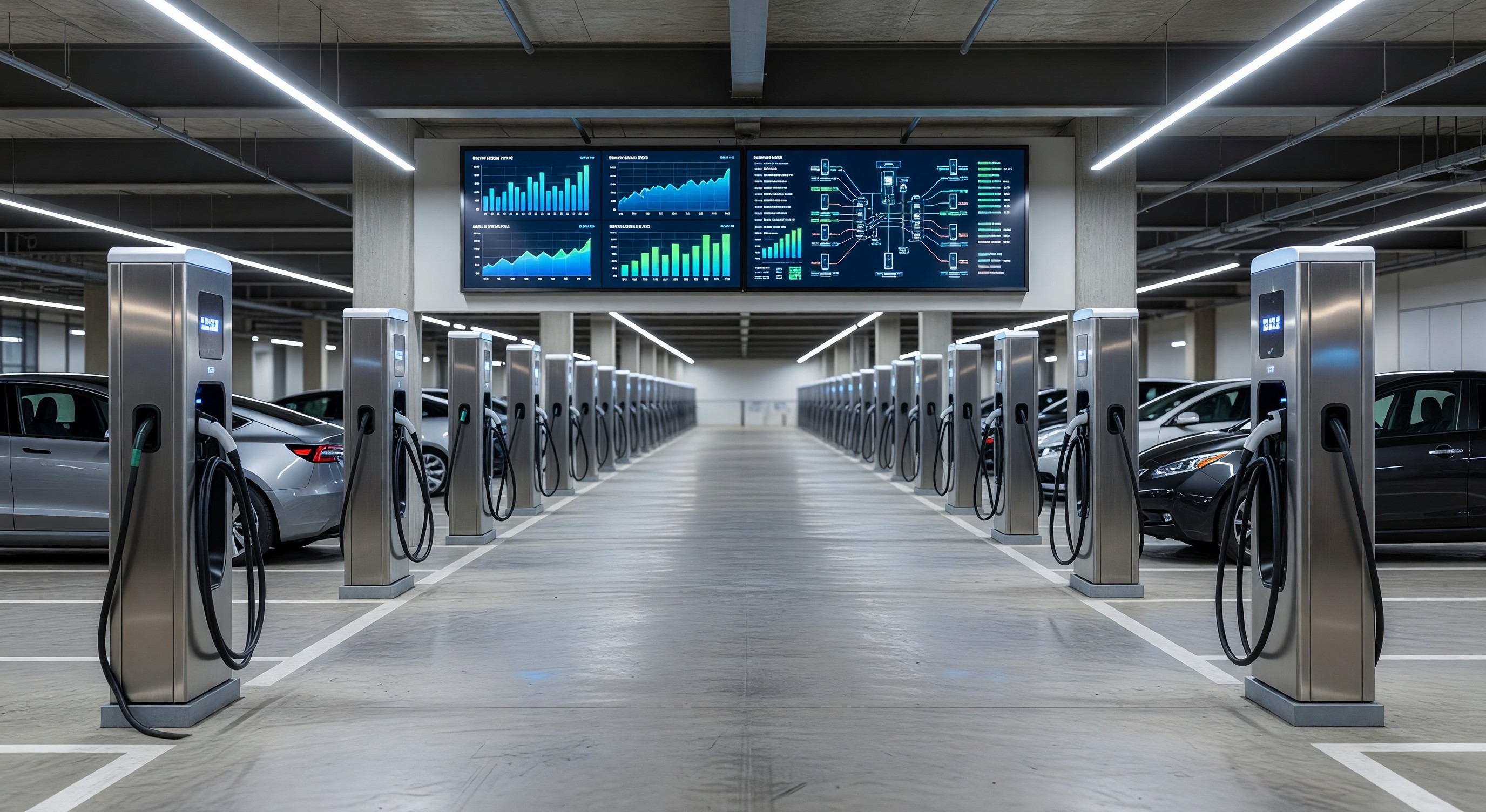
When parking facilities deploy EV charging infrastructure at significant scale — dozens or hundreds of Level 2 chargers and DC fast chargers — they become something new in the energy system: large, distributed, and controllable electrical loads with connected vehicles that may represent substantial stored energy capacity. The grid operators who manage electricity supply and demand across regional networks have taken notice.
The integration of parking EV charging with smart grid programs is moving from pilot phase to commercial deployment in several markets. The economic logic is compelling on both sides: grid operators need controllable load flexibility to balance supply and demand as renewable generation grows more variable; parking facilities need to manage the substantial electricity costs that large EV charging deployments create. Smart grid programs create mechanisms for both to benefit from the same resource.
This article examines how parking-to-grid integration works, what the key technologies are, where the revenue and cost-reduction opportunities lie, and what operators considering grid integration should understand before committing.
Why Parking Facilities Are Valuable Grid Resources
The Grid Integration Challenge
The modern electrical grid is becoming more variable on both the supply and demand side. Solar and wind generation produce power in proportion to weather conditions, not human electricity demand. Demand itself is growing more volatile as electrification adds large, concentrated loads (EV charging, heat pumps, data centers) that were not present in historical load profiles.
Grid operators manage this variability through dispatchable generation (power plants that can ramp up and down on command), storage (batteries that absorb excess supply and discharge during shortage), and demand response (reducing or shifting controllable loads during stress periods). All three resources have costs; all are in demand.
Parking EV charging represents a highly controllable demand resource. Unlike industrial processes that cannot easily be curtailed, EV charging sessions at a parking facility can be ramped down, shifted in time, or interrupted entirely without harm to the vehicle — as long as the vehicle achieves its required state of charge before the driver returns. A parking facility with 100 Level 2 chargers operating simultaneously represents 1,000 to 1,900 kW of controllable load that can be reduced to near zero in seconds, or distributed across an 8-hour dwell window rather than concentrated in the first two hours after arrival.
Demand Response Programs
Demand response is the most broadly available grid integration opportunity for parking facilities today. Utilities and independent system operators in most U.S. markets offer demand response programs that pay commercial customers to reduce electricity consumption during defined peak or emergency periods.
Enrollment in demand response programs typically requires a minimum curtailable load — often 100 kW or more for commercial programs. A parking facility with 15 or more Level 2 chargers can meet this threshold. When the grid operator calls a demand response event (typically 4 to 24 hours in advance), the facility’s energy management system reduces EV charging rates or sequences charger availability, dropping load below the contracted curtailment level. The facility receives a payment — typically $50 to $150 per kW of curtailed capacity per year, plus event-based payments for actual curtailments — in exchange for this reliability.
The U.S. Department of Energy’s Office of Electricity and the Alternative Fuels Data Center at afdc.energy.gov maintain resources on EV charging grid integration programs, including state-by-state demand response program availability for transportation electrification loads.
Smart Charging (Managed Charging)
Smart charging — also called managed charging or load management — is the foundational technology that enables grid integration. Rather than allowing all connected EVs to charge at maximum rate simultaneously, smart charging software coordinates charging across all connected vehicles to stay within defined electrical constraints.
In the basic implementation (facility-level demand management), smart charging reduces peak demand within the facility, directly lowering demand charges on the electricity bill. This is the first-order financial benefit that applies in nearly every large EV charging deployment, with or without any utility program enrollment.
In more sophisticated implementations (utility-integrated smart charging), the smart charging software responds to signals from the utility or grid operator — price signals, dispatch commands, or automated demand response triggers — adjusting charging behavior in real time to provide grid services.
The Vehicle Grid Integration Council provides frameworks for utility-EV charging integration that inform how operators structure participation in grid programs, with technical standards documentation available through the relevant utility interconnection requirements.
Vehicle-to-Grid (V2G): The Next Level
What V2G Means for Parking Operators
Vehicle-to-grid (V2G) technology enables bidirectional power flow: not just drawing power from the grid to charge EVs, but using EVs as storage resources that can discharge electricity back to the grid when needed.
The potential economic value is substantial. A fully charged EV with 60 to 100 kWh of usable battery capacity can supply several hours of electricity at peak grid rates. A parking facility with 50 EVs parked for 8 hours represents 3,000 to 5,000 kWh of potentially dispatchable storage — comparable to a small utility-scale battery system.
V2G services that parking facilities could in principle provide include: energy arbitrage (charge when electricity is cheap, discharge when it is expensive), frequency regulation (rapidly inject or absorb power to maintain grid frequency), and operating reserves (stand ready to discharge on short notice if a generator fails).
Current V2G Deployment Status
V2G for parking applications is at an earlier commercial stage than smart charging or demand response. The primary constraints are:
Vehicle-side capability. V2G requires bidirectional onboard chargers (OBCs) that most EVs currently lack. CHAdeMO-standard vehicles (primarily older Nissan Leafs and some commercial vehicles) are V2G capable. The newer bidirectional standards — SAE J3068 for AC bidirectional and ISO 15118-20 for DC bidirectional — are beginning to appear in new vehicle models as of 2025, with Ford, Nissan, and several commercial vehicle manufacturers having made the most significant commitments.
Infrastructure cost. Bidirectional EVSE (Electric Vehicle Supply Equipment) capable of V2G costs significantly more than unidirectional Level 2 charging equipment — typically 2 to 4 times more for comparable power levels. DC bidirectional chargers capable of V2G at useful power levels (10 to 25 kW per vehicle) are at the premium end of infrastructure cost.
Utility tariff and interconnection. V2G requires export-capable interconnection agreements with the local utility and tariff structures that compensate for exported energy. Both are available in some markets and absent in others. California and Hawaii have the most developed V2G utility engagement frameworks in the United States; most other markets are still establishing the regulatory foundations.
Battery warranty concerns. Some EV manufacturers have historically expressed concern that V2G use — adding cycles to the battery that weren’t planned for in the warranty — would affect battery warranty coverage. This is an evolving area; several manufacturers have explicitly confirmed that V2G use does not void warranty on V2G-capable models, but operators should verify for the specific vehicle population they serve.
Vehicle-to-Building (V2B) as an Interim Step
Vehicle-to-building (V2B) — using EV batteries to supply electricity to the facility rather than to the external grid — is technically and economically simpler than full V2G. V2B does not require utility interconnection for export, only the facility’s own electrical system. It directly reduces peak demand and provides backup power capability during outages.
For parking facilities with backup power obligations (hospitals, emergency services facilities) or those seeking to maximize solar self-consumption, V2B is a near-term viable application using hardware that is becoming available in 2024 and 2025. The Ford F-150 Lightning’s Pro Power Onboard, the GM Ultium-based bidirectional charging system, and several commercial bidirectional EVSE platforms are enabling V2B deployments before the V2G market fully matures.
Financial Modeling for Grid Integration
Stacking Revenue Streams
The economic case for grid integration depends on stacking multiple revenue and cost-reduction streams:
- Demand charge reduction — smart charging reduces peak kW, lowering demand charges. In commercial electricity tariffs where demand charges represent 30 to 50 percent of the bill, this is typically the largest single financial benefit of smart charging.
- Demand response payments — utility or ISO payments for enrolled curtailable capacity and actual curtailment events.
- Time-of-use optimization — shifting charging toward off-peak hours when energy rates are lower.
- Ancillary services revenue (where available) — frequency regulation and spinning reserve markets pay for fast-response load flexibility.
- V2G energy arbitrage (future) — charging at off-peak rates, discharging at on-peak rates, capturing the spread.
For a 100-charger facility in a favorable market (California, Northeast, Pacific Northwest), the combined financial benefit from items 1 through 3 alone can materially offset the incremental cost of smart charging infrastructure. Items 4 and 5 represent upside as V2G markets mature.
Grid Integration Platform Selection
Smart grid integration for parking EV charging requires a software platform that manages charging behavior, communicates with utility systems, tracks financial performance, and reports compliance with demand response program commitments. Key capabilities to evaluate:
- OpenADR compatibility (the standard protocol for automated demand response in the United States)
- OCPP (Open Charge Point Protocol) support for charger interoperability
- Real-time energy monitoring and demand charge prediction
- Integration with facility energy management systems (for V2B applications)
- Reporting and settlement documentation for utility programs
The U.S. Department of Energy’s Vehicle Technologies Office publishes research on EV charging infrastructure and grid integration technology at energy.gov, including performance data from federally funded demonstration projects.
What Operators Need Before Pursuing Grid Integration
Baseline electrical infrastructure. Grid integration amplifies the value of existing EV charging infrastructure — it does not work without it. Smart grid programs for parking require a meaningful installed charger base and metered electrical data to establish demand baselines.
Utility program research. The programs available vary enormously by utility and market. Before investing in smart charging software with specific grid integration capability, identify which programs your local utility offers, what the qualification requirements are, and what compensation structures apply.
Customer impact assessment. Demand response events that reduce charging speed or temporarily suspend charging sessions must be managed so that vehicles achieve required charge levels before drivers return. In short-dwell facilities (retail, quick service), demand response headroom is limited. In long-dwell facilities (office, residential, airport), it is substantial. Know your dwell profile before committing to curtailment programs.
Legal and interconnection review. V2B and V2G applications require review of utility interconnection requirements, potential net metering or export tariff obligations, and any permit requirements for bidirectional electrical systems. These vary by jurisdiction and utility.
The parking facilities that position themselves as grid assets — not just electricity consumers — will have a meaningful advantage as electricity costs rise with EV adoption and as utility programs for flexible commercial loads become more valuable. The technology is available today for smart charging and demand response. V2G is approaching viability for facilities with the right vehicle population and market context. The operators who build the infrastructure and program relationships now will be first to capture the emerging value.
Related reading: EV Charging and Parking Infrastructure: Planning for the Electric Transition and EV Charging Load Management in Parking for the foundational infrastructure context.
Frequently Asked Questions
What is smart charging for parking facilities?
Smart charging (also called managed charging or load management) coordinates EV charging across all connected vehicles to stay within defined electrical capacity limits, rather than allowing all vehicles to charge at maximum rate simultaneously. This reduces peak demand, lowering demand charges on the electricity bill. More sophisticated implementations respond to utility price signals or demand response dispatch commands, enabling grid services participation.
What is vehicle-to-grid (V2G) and is it available for parking facilities today?
V2G allows EVs to discharge electricity back to the grid, using vehicle batteries as distributed energy storage. Commercial V2G for parking facilities is in early deployment — it requires bidirectional-capable vehicles (most current EVs do not have this) and bidirectional EVSE infrastructure. Demand response and smart charging are available today in most U.S. markets. V2G is viable in select markets (primarily California) with the right vehicle and infrastructure combination, and is expanding as new bidirectional-capable vehicles enter the market.
What is demand response and how do parking facilities participate?
Demand response programs pay commercial customers to reduce electricity consumption during grid stress periods. Parking facilities enroll a defined amount of curtailable EV charging load (typically 100 kW minimum) and receive annual capacity payments. When the utility calls a demand response event, the facility’s energy management system reduces EV charging rates or sequences charger availability to achieve the contracted curtailment. Events are typically called 4 to 24 hours in advance.
How much can grid integration reduce a parking facility’s electricity costs?
In markets with commercial time-of-use electricity rates and demand charges, smart charging combined with demand response participation can reduce EV charging electricity costs by 20 to 40 percent compared to unmanaged charging. The largest component is typically demand charge reduction, which can represent 30 to 50 percent of the total electricity bill for large EV charging loads. Revenue from demand response capacity payments adds an additional benefit of $50 to $150 per kW of enrolled capacity per year.
What software protocols are used for smart grid integration in parking?
The primary protocols are OpenADR (Open Automated Demand Response) for utility-to-facility communication about demand response events, and OCPP (Open Charge Point Protocol) for communication between the energy management software and individual EV chargers. OCPP versions 1.6 and 2.0.1 are the current standards; V2G applications use ISO 15118 for vehicle-to-charger communication. Operators should verify that charger hardware and energy management software support these open standards rather than proprietary protocols.
What utility programs are available for parking EV charging grid integration?
Program availability varies by utility and market. California has the most developed programs, including Pacific Gas & Electric, Southern California Edison, and San Diego Gas & Electric EV-specific demand response and smart charging incentive programs. Northeast utilities including National Grid, Eversource, and ConEd offer commercial demand response programs that include EV charging loads. The Alternative Fuels Data Center at afdc.energy.gov maintains a database of state-level EV charging incentive and grid program availability.
Further Reading From Authoritative Sources
- Alternative Fuels Data Center — EV Charging and Grid Integration: The U.S. DOE’s AFDC provides comprehensive resources on EV charging infrastructure, grid integration programs, and state-by-state incentive availability for transportation electrification.
- U.S. Department of Energy — Vehicle Technologies Office: The DOE Vehicle Technologies Office funds and publishes research on EV charging infrastructure, smart charging, V2G technology, and grid integration demonstrations across the United States.