The shorthand circulating among operators is that the EU now wants one EV charger for every 20 parking spaces. The directive says something different, and the difference matters for budgets. Twenty is the size threshold that pulls a building into scope. The charging ratio that applies from 1 January 2027 is one recharging point for every 10 spaces, with an alternative that costs far less up front.
The source is Article 14 of Directive (EU) 2024/1275, the recast Energy Performance of Buildings Directive (EPBD), published in the Official Journal in May 2024. This article works from that text, not from vendor summaries.
What Article 14(2) actually says
For “all non-residential buildings with more than 20 car parking spaces,” Member States must ensure, by 1 January 2027, one of two things:
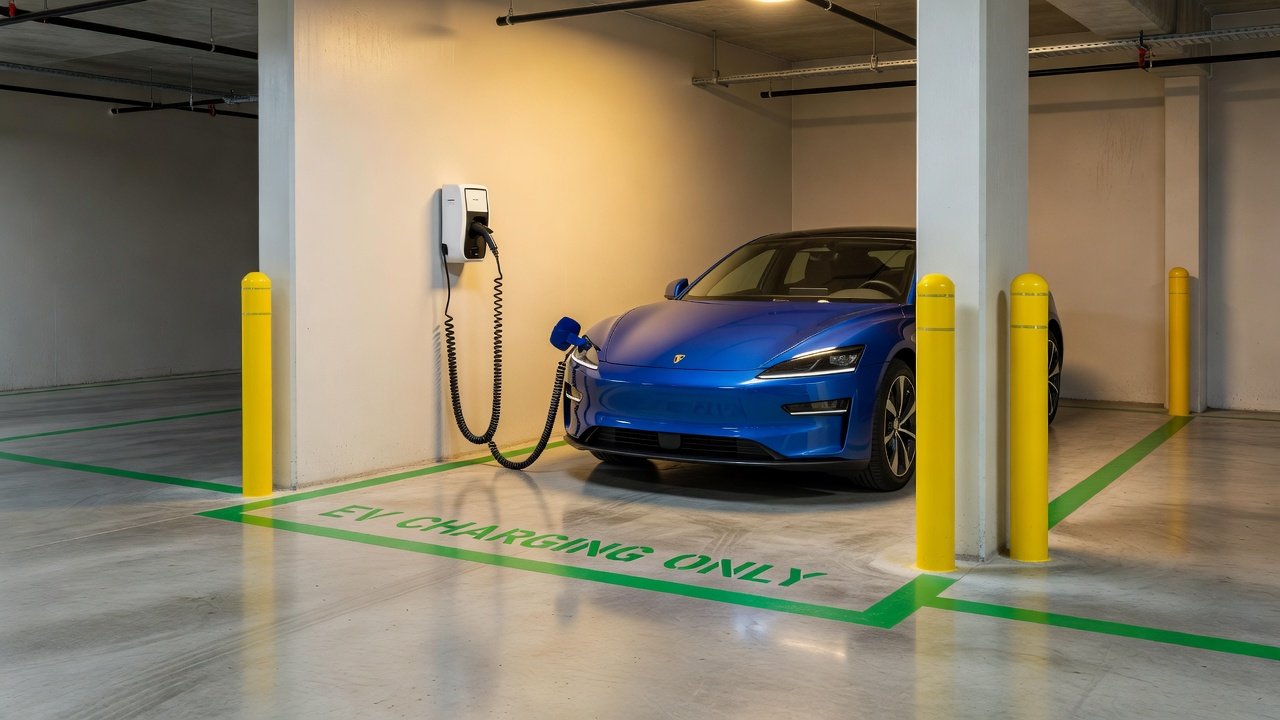
- the installation of at least one recharging point for every 10 car parking spaces; or
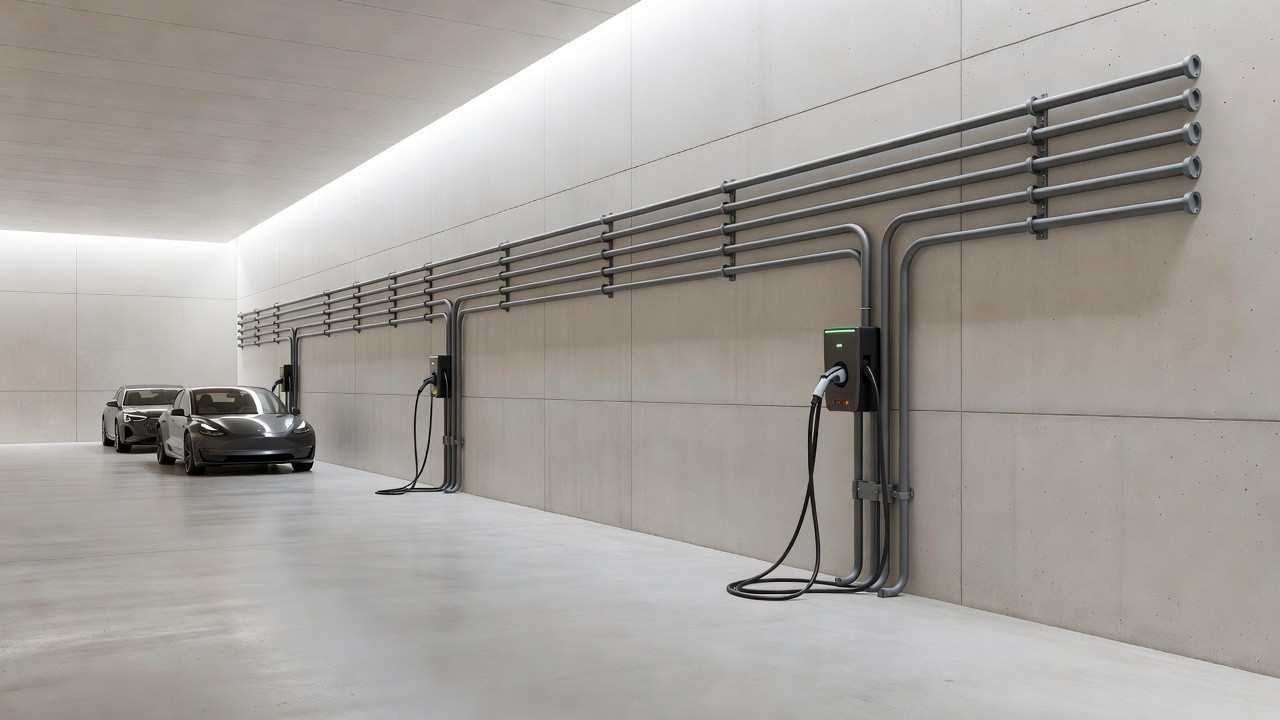
- ducting (conduits for electric cables) for at least 50% of the car parking spaces, so recharging points can be added later.
The same paragraph adds bicycle parking equal to at least 15% of average user capacity or 10% of total user capacity.
Three points follow from the wording.
It covers existing buildings. Unlike the new-build and major-renovation rules in Article 14(1), the 2027 duty is not triggered by construction work. A retail park, hospital, office campus or municipal car park built years ago falls in scope the moment it has more than 20 spaces.
Ducting satisfies the rule on its own. The “or” is real. An owner can meet the 2027 obligation with conduit for half the spaces and no chargers at all. Running conduit is simplest while a floor or surface is already open for other works; cutting it in later means breaking finished surfaces.
Public bodies carry an extra step. For buildings owned or occupied by public bodies, Member States must ensure pre-cabling for at least 50% of spaces by 1 January 2033. Pre-cabling goes beyond empty conduit, so municipal operators should plan for two stages, not one.
There is also a narrow delay. Member States may postpone the requirement until 1 January 2029 for non-residential buildings renovated in the two years before 28 May 2024, where that renovation complied with national requirements under the earlier directive.
How it differs from the new-build rules
Article 14(1) is much stricter, and operators who confuse the two will misjudge both. For new non-residential buildings and those undergoing major renovation with more than five spaces, the directive requires:
- at least one recharging point for every five spaces;
- pre-cabling for at least 50% of spaces and ducting for the rest;
- one recharging point for every two spaces for new or majorly renovated office buildings.
The European Commission’s summary of the directive dates the office and other non-residential new-build requirements from 30 May 2026 and the large-car-park requirement from 1 January 2027. If you are building or fully renovating a facility now, the five-space ratio governs, not the 2027 existing-stock rule.
Technical conditions that apply to the chargers
Article 14(6) requires that recharging points under paragraphs 1, 2 and 4 be capable of smart recharging and, where appropriate, bi-directional recharging. They must run on non-proprietary and non-discriminatory communication protocols, in an interoperable way, in line with European standards under Regulation (EU) 2023/1804, the Alternative Fuels Infrastructure Regulation.
That has a practical effect on procurement. A charger that locks you into one back-end vendor’s closed protocol is a poor fit for a directive that asks for open standards. Ask suppliers which protocols and standards their hardware supports and how load management is configured. Article 14(1) also requires ducting and pre-cabling to be dimensioned for simultaneous, efficient use and, where appropriate, load or recharging management. That requirement sits in the new-build paragraph, but it is a sensible design target for any retrofit, because a 100-space garage with ducting for half its bays still needs a feeder that can support what drivers will eventually plug in.
Exemptions are narrow
Member States may choose not to apply paragraphs 1, 2 and 4 to specific categories of building in two cases. One is where the required infrastructure would rely on micro-isolated systems, or the buildings are in outermost regions, and compliance would endanger the stability of the local grid. The other is where the cost of the recharging and ducting installations exceeds at least 10% of the total cost of a major renovation. Neither is a general hardship clause, and each depends on how the country writes it into law.
Fire safety is a live issue too. Article 14(10) required the Commission to publish guidance for fire safety in car parks by 31 December 2025. Underground and enclosed garages should check that guidance against their insurer’s requirements before specifying charger density.
What operators should do now
Member States had until 29 May 2026 to bring most of the directive into national law, including the articles that contain these duties. National texts decide enforcement, penalties and any use of the options above, so the first step is to read your own country’s transposition, not the directive alone. Transposition status varies, and any national date or ratio that differs from the directive text should be treated as authoritative for your site.
A workable sequence for a site above 20 spaces:
- Count spaces as the national rule defines them, including any adjacent surface lots that belong to the same building.
- Decide between chargers at one per 10 spaces and ducting for half. Ducting alone satisfies the 2027 text, so chargers can follow as demand appears; price both routes for your site.
- Check electrical capacity at the main distribution board before any trenching. Supply upgrades can change the economics of either route, so get a utility quote early.
- If you are public sector, plan the pre-cabling stage for 2033 alongside the 2027 work, so the trench is opened once.
- Write open-protocol and smart-charging requirements into every charger tender.
The 2027 deadline is less about chargers than about not closing off the option. Operators who run conduit while a floor is open will meet the rule at modest cost. Those who wait will pay to cut it in later.