For decades, parking operators set prices and staffing levels the same way they always had: experience, seasonal calendars, and a reasonable guess about what Friday night would look like. That approach worked tolerably well when parking was a static utility. It breaks down in a world where a stadium event, a transit disruption, a sudden rainstorm, and a new rideshare pickup zone can all hit the same block in the same hour.
Machine learning demand forecasting changes the operating model. Instead of reacting to conditions after they develop, operators and city planners can see demand shifts coming hours — or days — in advance, then adjust pricing, staffing, wayfinding, and gate configuration before the wave arrives. This article examines how ML forecasting works in a parking context, what data it actually requires, where it creates real operational value, and what the honest limitations are for teams considering deployment.
Why Traditional Forecasting Falls Short
Conventional parking demand management relies on two inputs: historical averages and known event calendars. A structure that fills to 90 percent capacity every Saturday between noon and 4 p.m. will be priced and staffed accordingly. The model works until it doesn’t — until the farmers market two blocks away moves locations, the sports team goes on a road trip, or a construction closure reroutes two thousand daily commuters through your lot.
Static models have three structural weaknesses:
- Lag: They encode past behavior but cannot anticipate structural shifts until enough new data accumulates to reset the baseline.
- Granularity: Hourly or daily averages mask 15-minute spikes that determine real customer experience and revenue capture.
- Independence: They treat each lot or structure in isolation, ignoring how supply changes at one facility ripple across neighboring blocks.
ML forecasting addresses all three by continuously ingesting fresh signal data, generating short-window predictions, and modeling spatial interdependencies across a parking network.
The Data Foundation: What Actually Drives Parking Demand
Before evaluating any ML platform or building an internal model, operators need to understand the variables that meaningfully predict parking demand. Not all of them are obvious.
Primary Demand Signals
| Signal Category | Examples | Update Frequency |
|---|---|---|
| Occupancy history | Gate counts, LPR entry/exit timestamps | Real-time |
| Event data | Venue calendars, conference schedules, festivals | 1–7 days ahead |
| Weather | Precipitation, temperature, wind | Hourly forecast updates |
| Transit status | Bus/rail delays, service suspensions | Real-time |
| Day/time structure | Hour of day, day of week, month, holidays | Static |
| Local business activity | Restaurant reservation density, retail foot traffic | Daily aggregates |
Secondary Signals That Improve Accuracy
Several data sources are underused in parking forecasting but measurably improve model precision:
- Navigation app query volume. When searches for a neighborhood spike in Google Maps or Waze — ahead of an unannounced event or a trending location — parking demand typically follows within 45 to 90 minutes. Some smart parking platforms now ingest anonymized navigation API data for exactly this reason.
- Social media event signals. Large-scale gatherings are often detectable in geo-tagged post volume or trending hashtags before they show up in any official event feed.
- Rideshare surge pricing zones. High rideshare surge in an area often corresponds to peak parking demand. When surge rates are publicly available, they serve as a leading indicator.
- Construction and lane closure data. Municipal open data portals increasingly publish permit data. A road closure two blocks away can shift 200 vehicles per day into a nearby structure.
The practical implication: the more diverse the input data stack, the more resilient the model becomes to novel conditions that fall outside historical patterns.
ML Approaches Used in Parking Demand Forecasting
There is no single canonical approach. The right architecture depends on the forecasting horizon, the granularity required, and the available data volume.
Short-Horizon Forecasting (0–4 Hours)
For operational decisions — gate configuration, dynamic pricing adjustments, staff dispatch — operators need predictions in the 15-minute to 4-hour window. Gradient boosted tree models (XGBoost, LightGBM) perform well here because they handle tabular data efficiently, train quickly on modest hardware, and produce highly interpretable feature importance scores. Operators can see exactly why the model is predicting a spike: “70% weight on the venue calendar, 20% weight on current weather.”
Recurrent neural networks (LSTMs) have also shown strong results for short-horizon occupancy forecasting, particularly in facilities with high transient traffic where sequential patterns matter — the last 30 minutes of arrivals is often the best predictor of the next 15.
Medium-Horizon Forecasting (4–48 Hours)
Planning staffing levels, preparing for dynamic pricing windows, and pre-positioning EV charging capacity requires forecasts in the 4-to-48-hour range. Ensemble approaches — combining a gradient boosted model with a time-series component (Prophet, ARIMA) — tend to outperform single-model approaches in this window. The time-series component captures recurring weekly patterns; the tree model handles exogenous events.
Strategic Forecasting (1–12 Weeks)
For revenue planning, capital deployment decisions, and rate card development, longer-range forecasting uses regression models with event-adjusted seasonality. These are less precise but provide planning ranges with calibrated confidence intervals — enough to make defensible budget decisions.
Operational Applications: Where Forecasting Creates Value
Dynamic Pricing That Leads Instead of Lags
Most dynamic pricing systems today are reactive: they raise rates when occupancy exceeds a threshold (say, 85%) and lower them when it falls below a target floor. The problem is that by the time the pricing trigger fires, demand is already at the lot. Drivers who might have been influenced to park elsewhere or at a different time have already committed.
Predictive dynamic pricing fires the adjustment in advance. If the model forecasts 93% occupancy in 90 minutes, rates increase now — when there is still time for demand response. Early studies from municipal smart parking pilots in several North American cities have documented 8–15% reductions in peak congestion with predictive pricing versus threshold-only systems.
Staffing and Operational Readiness
ML forecasting has a less glamorous but immediately impactful application: predicting when human staff are actually needed. Parking operations are heavily labor-leveraged — cashiers, attendants, enforcement officers, and maintenance crews represent a significant share of operating cost. Models that forecast shift-level demand with reasonable accuracy allow operators to reduce unnecessary coverage during off-peak periods and ensure adequate staffing before peaks arrive.
For operators running 10 or more facilities, forecasting-driven scheduling can meaningfully compress labor cost without degrading service levels.
Proactive Wayfinding and Inventory Management
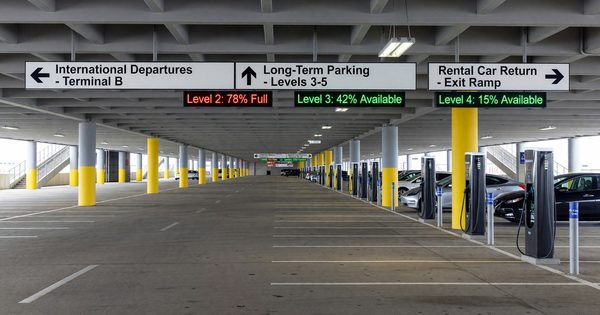
When a demand forecast predicts that Structure A will fill by 7:30 p.m., the parking guidance system can begin routing drivers toward Structure B at 7:00 p.m. — before Structure A fills — rather than after it shows FULL. This is the difference between wayfinding that prevents frustration and wayfinding that documents it.
City-scale implementations of predictive wayfinding are now operating in several European smart city programs, where centralized parking management platforms aggregate occupancy across 20–50 facilities and continuously rebalance guidance messaging based on forward-looking forecasts rather than current-state occupancy alone.
Revenue Forecasting and Rate Card Development
Demand forecasting feeds upward into financial planning. When operators can model expected occupancy distributions across 52 weeks — accounting for event calendars, seasonal adjustments, and macro trends — they can build rate cards that maximize revenue capture across the full demand curve rather than setting flat rates based on peak assumptions.
For municipal parking authorities, accurate demand forecasting also improves the defensibility of rate change proposals. Regulators and city councils respond better to data-driven projections than to qualitative claims about market conditions.
Implementation Considerations
Data Infrastructure Prerequisites
ML forecasting is only as good as the data that feeds it. Before evaluating models, operators should assess whether their current infrastructure can support:
- Continuous, timestamped occupancy data — gate counts alone are insufficient; enter/exit timestamps enable true occupancy calculation at 15-minute granularity
- Reliable event data ingestion — a structured process for importing venue calendars and municipal event permits
- Weather API integration — at minimum, forecast precipitation and temperature for the relevant geography
- Historical data depth — most ML approaches require 12–18 months of clean history to produce reliable seasonal models; less than 6 months produces high-uncertainty outputs
Build vs. Buy
The build-versus-buy question in parking ML forecasting is more nuanced than in most technology decisions.
| Consideration | Build Internal | Buy Platform |
|---|---|---|
| Data ownership | Full control | Depends on contract terms |
| Customization | High | Limited to platform options |
| Initial investment | High (data science talent) | Moderate (SaaS subscription) |
| Time to first forecast | 6–18 months | 2–6 months |
| Maintenance burden | Internal team ongoing | Vendor-managed |
| Multi-facility scalability | Complex | Usually built in |
For operators with fewer than 20 facilities, dedicated ML platforms — several of which now offer parking-specific modules — typically deliver better ROI than internal builds. Larger municipal programs and major private operators with proprietary data advantages may find the internal build defensible, particularly when forecasting integrates tightly with proprietary revenue management systems.
Handling Model Drift
One of the most underappreciated challenges in production ML systems is concept drift: the gradual degradation of model accuracy as the real world changes in ways the training data does not capture. In parking, drift drivers include neighborhood development, new transit infrastructure, zoning changes, and evolving commute patterns.
Robust implementations include automated accuracy monitoring — comparing forecasts to actuals on a rolling basis — with alert thresholds that trigger model retraining when error rates exceed acceptable bounds. Operators who deploy a forecasting model and never update it should expect accuracy degradation within 12–18 months in high-change urban environments.
The Forward View: Forecasting as Infrastructure
The most significant shift in parking demand forecasting is not any individual algorithmic advance. It is the movement toward treating forecasting as infrastructure rather than a project.
Cities and operators that embed predictive demand data into decision workflows — pricing systems, guidance platforms, staffing tools, financial planning — develop a compounding advantage. Each operational decision improves the data quality that feeds the next forecast cycle. The model gets better because operations get better, and operations get better because the model gets better.
Emerging integrations extend this feedback loop further. Connections to city traffic management platforms allow parking forecasts to inform signal timing. Integrations with transit APIs let parking operators adjust dynamic pricing in real time when a train delay is pushing an unexpected 400 commuters toward the surface lot. As urban mobility data becomes more interconnected, parking demand forecasting will increasingly function as a node in a city-scale intelligence network rather than a standalone facility management tool.
The operators and planners who are building that infrastructure now — not waiting for perfect data or perfect models — will be positioned to extract the most value as the connected city matures.
Smart Parking World covers technology, data, and strategy at the intersection of parking and urban mobility. Explore more in our Analytics section.