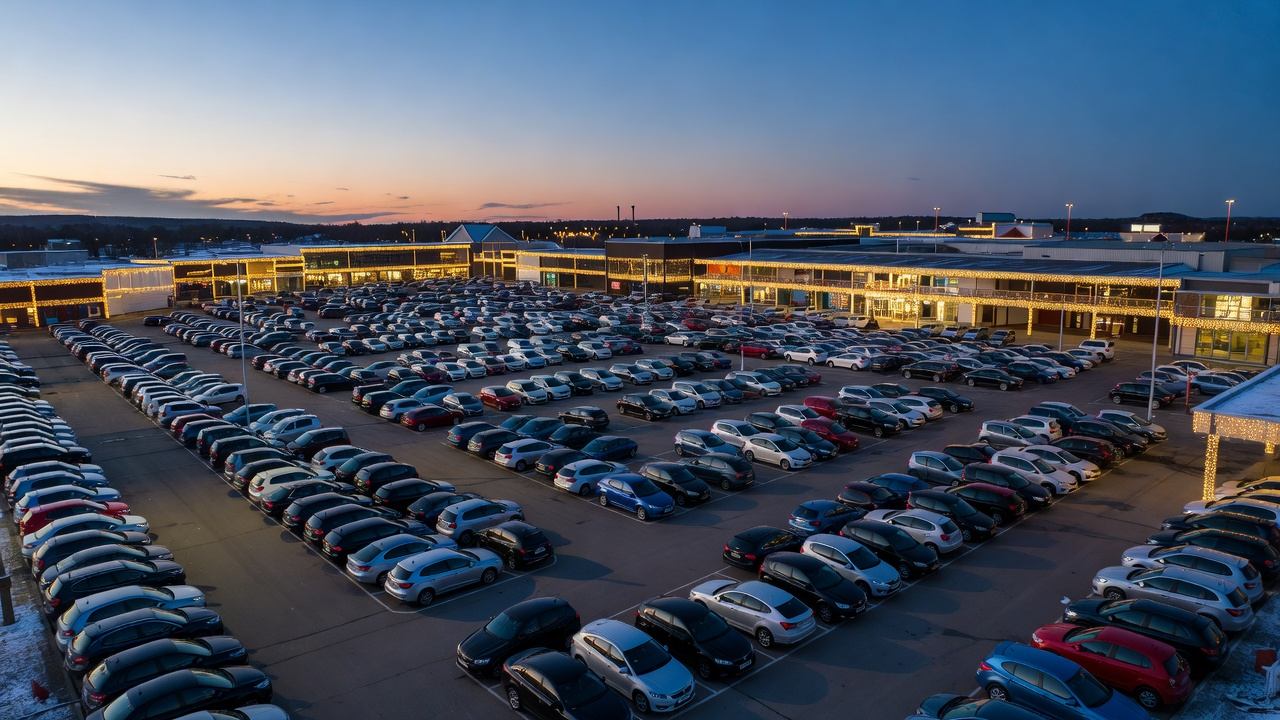
A shopping centre car park can run comfortably for ten months and still lose its reputation in ten days. The holiday peak compresses a year of demand into a few afternoons, and the shopper who circles a full structure for 20 minutes does not remember the other 350 days. For operators with sensors or counting systems already installed, the useful question is not whether to collect occupancy data but what to do with it before the season starts.
The demand side is large and front-loaded
The US National Retail Federation forecast 2025 holiday sales (1 November to 31 December) at $1.01 to $1.02 trillion, growth of 3.7% to 4.2% over 2024, when sales reached $976.1 billion. The forecast was released on 6 November 2025, later than usual. NRF noted that a late Thanksgiving pushed Cyber Monday into December, which is a reminder that the calendar, not just the economy, decides where the peak lands.
Retail dollars are not parking demand, and no public source we found converts one into the other. Still, the direction is clear enough: every extra percentage point of foot traffic arrives at a car park whose capacity is fixed. A 4,400-space mall cannot add a floor in November.
Measure the shape of last year’s peak first
Before buying anything, pull last season’s entry and exit counts or ticket data and answer four questions:
- Which hours crossed 85% occupancy, and on which dates?
- How long did the facility stay above that line?
- Which levels, zones or lots filled first?
- What happened to dwell time during those hours?
Peaks are often narrower than assumed: a few weekend afternoons, plus the days around Black Friday and the last shopping weekend before the holiday, can account for most of the pain. The point of the exercise is to separate days that need an intervention from days that do not.
Guidance is the proven part
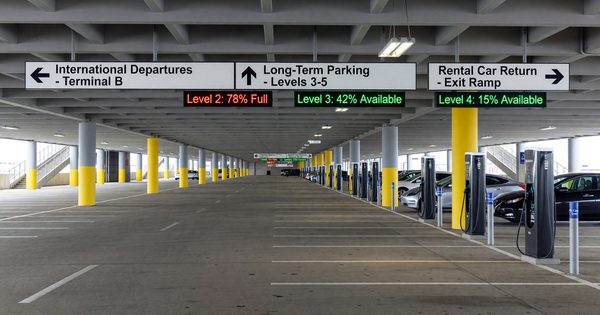
The best-documented tool for peak days is not pricing at all. It is telling drivers where the empty spaces are. Towson Town Center, a Maryland mall with about 4,400 parking spaces, installed Park Assist sensors and signs showing open spaces on each level, finishing before Black Friday 2017. The mall reported that average time spent looking for a spot fell 44%, according to a Baltimore Sun report cited by Retail Dive. The mall supplied the figure and no baseline period or method was published, and the system had not yet faced the Black Friday crowds when it was reported. Treat it as encouraging, not as a benchmark.
The mechanism is plausible and cheap to test. Per-level counts send drivers past full floors, which shortens searching and lowers the queue at the entrance. If you have counts, publish them on signs and in your app before you consider changing a single price.
What dynamic pricing has shown, and where it was tested
The strongest public evidence for occupancy-based pricing comes from San Francisco, and it concerns the street, not shopping centres. SFpark adjusted on-street rates using sensor data to aim for 60 to 80 percent occupancy. In the city’s evaluation, pilot areas hit the target occupancy 31% more often than control areas, blocks were full 16% less often, and average search time dropped by 5 minutes, or 43%. The SFMTA also reported a 30% reduction in vehicle miles travelled and emissions from cars circling for parking. These are the agency’s own figures from a comparison with control areas, and an independent academic study also found more areas meeting the 60 to 80% range.
The rules were also deliberately gentle. Per the SFMTA’s published method, the hourly rate rose by $0.25 on blocks that averaged 80 to 100 percent occupancy, stayed put at 60 to 80, and fell by $0.25 at 30 to 60 percent, with adjustments roughly every eight weeks. Nothing in that approach resembles a surge multiplier.
That distinction is the whole lesson for retail. Street parking is a public good with many alternatives nearby. A mall garage competes on goodwill, and a visibly higher price on the busiest day risks teaching customers that the centre charges them for shopping. We found no published, independent evaluation of dynamic pricing in a shopping centre garage during the holiday season, so any operator doing this is working with analogy, not proof.
A defensible plan for this season
Set the policy before the data arrives. Decide the occupancy bands, the maximum change and the lock-in period now, in writing. Changing rates mid-afternoon in response to a live counter invites complaints and mistakes.
Start with structure, not surge. Options that stay inside customer expectations include:
- a published peak-day tariff announced weeks ahead, rather than a live-changing price;
- free or discounted short stays at the edges of the peak, to move demand off the choke hours;
- validation tied to retailer spend, so tenants can offset parking cost where they choose to;
- reserved pick-up or click-and-collect bays kept clear of general demand.
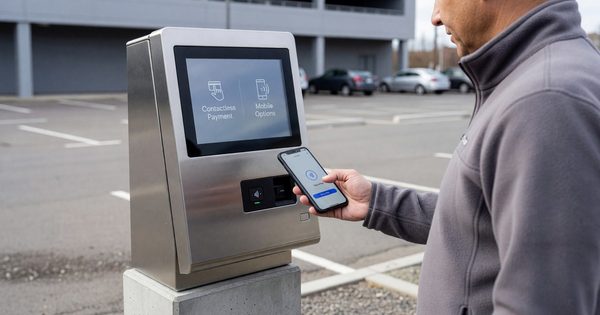
Fix measurement before changing prices. Pricing based on a miscounted car park is worse than no pricing. Reconcile sensor or gate counts against a manual count on a quiet day and again on the first busy weekend. Undercounting in particular sends drivers to a floor that is actually full.
Plan the overflow. When occupancy crosses your upper threshold, staff and signage should already be in place for remote lots, shuttle or valet options and rerouting at the entrance. A pricing change cannot create spaces; at best it moves some drivers to other hours.
Log everything. Record occupancy by zone, prices in force, complaints and tenant feedback each peak day. Next October, that log is the evidence the sector does not currently publish.
For most centres, the first-year gain comes from visibility: accurate counts, honest signs and a plan for overflow. Demand-based pricing can follow once the data is trustworthy and the policy is public, but its holiday-retail payoff remains largely unproven. Run this season as a measured test, not a conversion.